Lick Granuloma Vs Skin Allergy In Dogs: Key Differences

Your dog will not stop licking one spot, or maybe the itching seems to move from paws to belly to ears. Lick granuloma vs skin allergy in dogs — how do you tell the difference? The short answer is that a lick granuloma is usually a single thickened sore caused by repeated licking, while skin allergies usually cause broader itching, redness, and recurrent ear or paw problems.
If you can spot the pattern early, you can get the right treatment faster and avoid weeks of frustration. If your dog also licks feet often, this guide pairs well with why dogs lick their paws.
Lick granuloma vs skin allergy in dogs — how do you tell the difference?
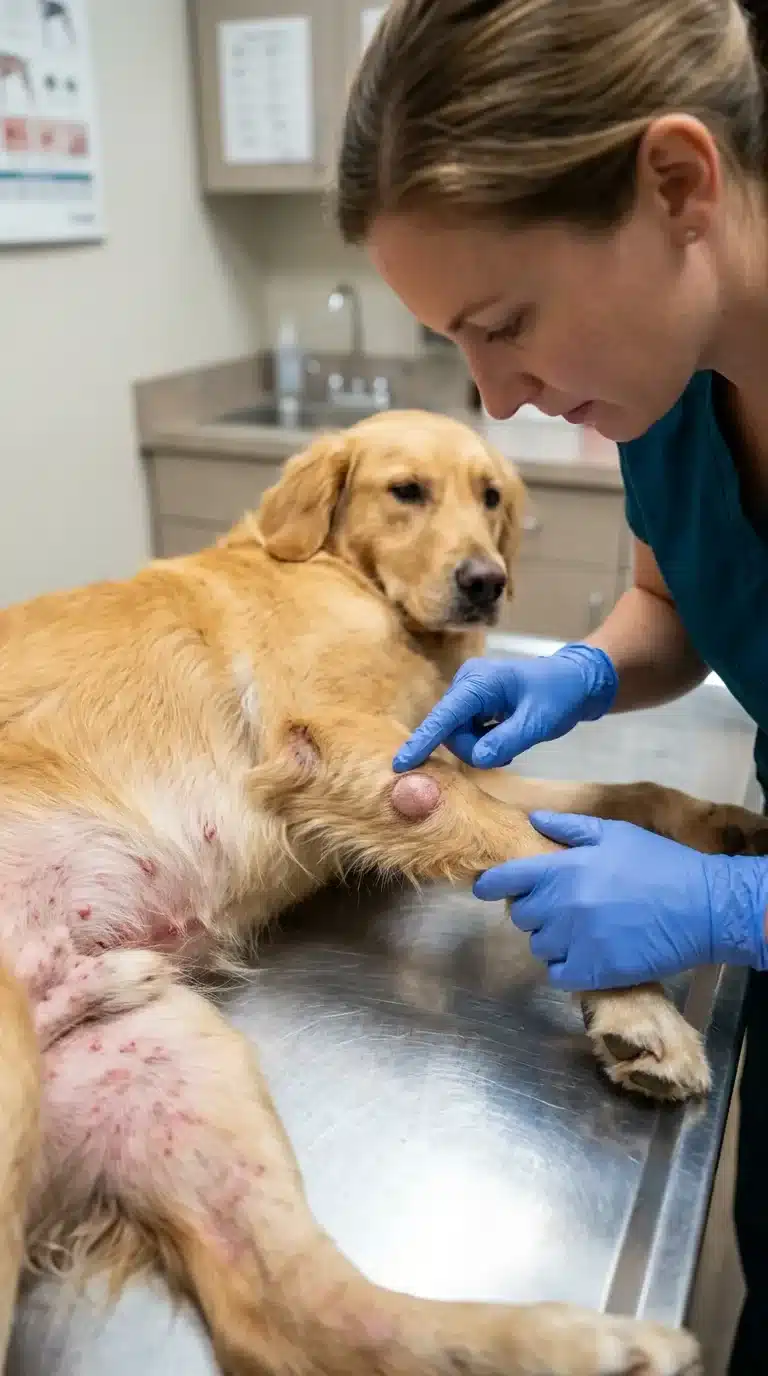
A lick granuloma usually looks like one localized, raised, hairless, thick, often moist lesion that keeps getting worse because the dog repeatedly licks it. A skin allergy usually causes itch in multiple places, often including paws, ears, face, armpits, groin, or belly, and the skin may look red, inflamed, or develop secondary infections.
- Lick granuloma is often one spot on a leg or paw.
- Skin allergy usually affects several body areas.
- Granulomas become thick, firm, and chronically irritated.
- Allergies often come with ear infections or paw chewing.
- Both can happen together in the same dog.
- A vet exam is often needed to confirm the trigger.
What does a lick granuloma look like compared with a skin allergy?
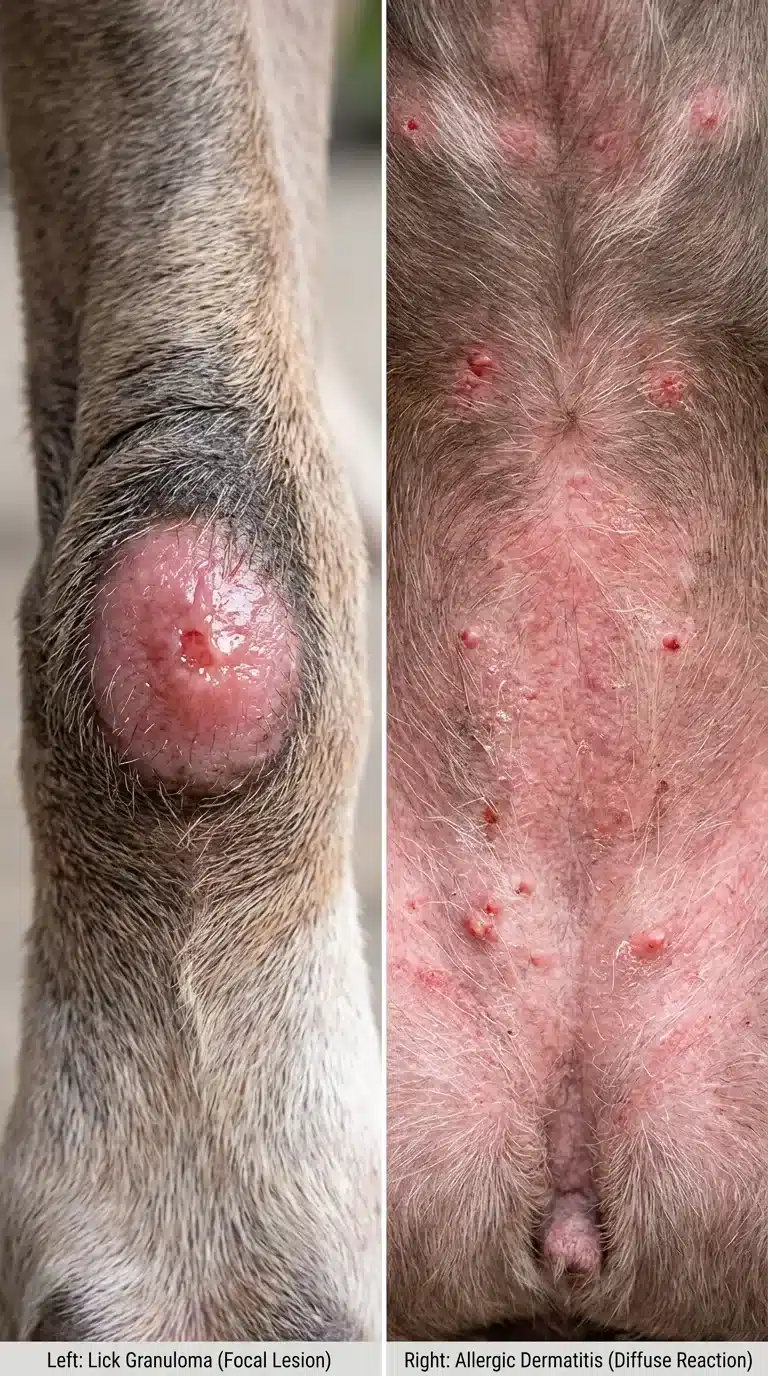
A lick granuloma is usually easier to spot because it tends to stay in one place and develop a very specific look. Skin allergies are more diffuse and often shift between body areas over time.
One stubborn lesion points more toward lick granuloma; widespread itch points more toward allergy.
Get Weekly Dog Care Tips Free
Join 10,000+ dog owners. Vet-approved advice every week
🔒 No spam. Unsubscribe anytime.
| Feature | Lick Granuloma | Skin Allergy |
|---|---|---|
| Pattern | Usually one main lesion | Usually multiple itchy areas |
| Common sites | Front legs, wrists, lower limbs | Paws, ears, belly, groin, face |
| Skin texture | Thick, raised, firm, ulcerated | Red, irritated, flaky, rash-like |
| Hair loss | Centered around one sore | Patchy or broader |
| Behavior | Obsessive licking of one spot | General scratching, rubbing, licking |
Veterinary dermatology texts describe acral lick dermatitis, often called a lick granuloma, as a self-perpetuating condition. Repeated licking causes inflammation, then the inflamed skin drives even more licking.
By contrast, allergic dermatitis often starts with itch caused by environmental allergens, flea allergy, or food allergy. The Merck Veterinary Manual notes that allergic skin disease commonly affects feet, face, ears, ventrum, and flexural surfaces rather than one isolated spot.
BEFORE YOU SCROLL PAST
Readers Also Loved:
👉 How To Spot Early Signs Of Canine Dementia In Senior Dogs
Typical appearance of a lick granuloma
The lesion often starts as a small raw patch. Over time, it can become oval, shiny, thickened, hairless, and darker than nearby skin.
- Usually on the front of the lower leg
- May ooze or crust
- Often feels firm or plaque-like
- Dog returns to it repeatedly
If you need to stop licking long enough to monitor the skin, a soft inflatable dog recovery collar can help some dogs tolerate the barrier better than a hard cone.
Typical appearance of skin allergy
Allergy skin changes may be subtle at first. You might see pink skin, staining from saliva on the paws, recurrent hot spots, ear debris, or rubbing around the face.
Secondary yeast or bacterial infections can blur the picture. If yeast is part of the problem, avoid random human creams and review can you use human yeast creams on dogs before applying anything.
What causes each condition, and can one lead to the other?
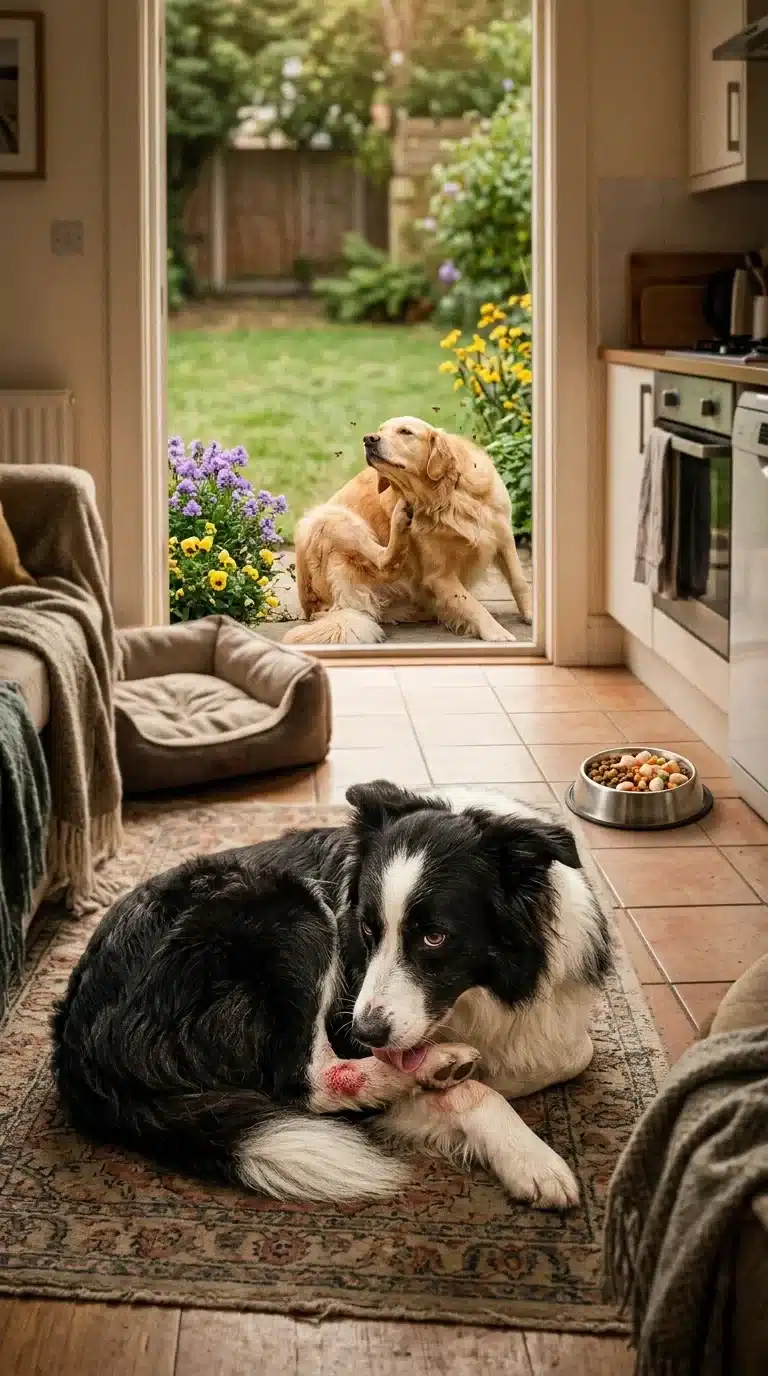
Lick granulomas are often driven by repeated self-trauma, but the trigger underneath may be pain, allergy, infection, boredom, anxiety, or a foreign body. Skin allergies are usually driven by flea allergy, environmental allergens, or food reactions, with itch as the main engine.
The American College of Veterinary Dermatology notes that allergies, parasites, infections, and pain all need to be ruled out when dogs chronically lick or chew their skin.
That overlap is why these two problems get confused. An allergic dog may start licking one itchy spot so much that it turns into a lick granuloma.
Likewise, a dog with joint pain or nerve irritation may create a lesion that looks like allergy at first glance. The appearance alone does not always tell the whole story.
BEFORE YOU SCROLL PAST
Readers Also Loved:
👉 How To Care For Your Female Frenchie During Her First Heat
Common triggers behind lick granuloma
- Arthritis or localized pain
- Nerve irritation or neuropathy
- Bacterial or yeast infection
- Allergy-driven itch
- Stress, frustration, or compulsive behavior
- Old injury, scar, or foreign material
Behavior can matter more in some dogs than owners expect. If stress or fear seems to fuel repetitive licking, this related guide on how past trauma or mistreatment influences a dog’s reaction may help you connect the dots.
Common triggers behind skin allergy
- Flea allergy dermatitis
- Environmental allergens like pollen or dust mites
- Food allergy, though less common than people assume
- Contact irritation from grass, cleaners, or surfaces
The World Association for Veterinary Dermatology and the International Committee on Allergic Diseases of Animals have published guidelines showing that canine atopic dermatitis often appears as recurrent itch, paw licking, ear inflammation, and ventral redness. Those patterns fit allergy better than a single thick sore.
What symptoms help you tell the difference at home?
The best home clue is distribution. If your dog is focused on one exact spot every day, think lick granuloma; if the itch shows up in several body zones, think allergy first.
Watch where your dog licks, not just how often.
- Check the number of spots. One main lesion leans toward granuloma.
- Look at the ears. Recurrent ear inflammation leans toward allergy.
- Inspect the paws. Multiple itchy feet suggest allergy more than granuloma.
- Feel the skin. Thick plaque-like skin suggests chronic self-trauma.
- Track timing. Seasonal flares suggest environmental allergy.
Dogs with allergies often scratch with their hind legs, rub the face, lick both front feet, or develop repeated ear issues. Dogs with lick granuloma may seem almost hypnotized by one spot and return to it even after a walk, meal, or distraction.
MOST POPULAR THIS WEEK
Readers Also Loved: 👇
👉 How To Stop Dogs From Scratching Ears Raw
Look for body-language differences too. Restless, generalized itch often comes with allergy, while focused licking during quiet moments can hint at pain or compulsive behavior.
Signs that point more strongly to skin allergy
- Itchy ears or repeated ear infections
- Licking or chewing multiple paws
- Rash on belly or groin
- Seasonal flare-ups
- Redness after grass exposure
If your dog has widespread skin irritation and you are comparing treatment paths, this article on natural alternatives to Cytopoint and Apoquel for dog skin issues gives useful background for that vet conversation.
Signs that point more strongly to lick granuloma
- One raised sore on a lower limb
- The same exact spot licked for weeks
- Lesion gets thicker, darker, and firmer
- Licking continues even when itch seems otherwise controlled
Taking daily photos helps because skin changes can be slow. A simple pet grooming clipper for dogs can make it easier to trim surrounding hair safely for monitoring if your veterinarian says the area can be kept visible.
How do vets diagnose lick granuloma versus skin allergy?
Vets diagnose these conditions by combining the lesion pattern, body distribution, skin tests, and the dog’s history. There is no single shortcut test that separates every lick granuloma from every allergy case.
| Diagnostic tool | Why it matters | Best for |
|---|---|---|
| Physical exam | Checks lesion shape and distribution | Both conditions |
| Skin cytology | Looks for yeast or bacteria | Secondary infection |
| Skin scraping | Rules out mites | Itchy dogs |
| Flea control trial | Tests flea allergy suspicion | Allergy workup |
| Diet trial | Checks food allergy | Chronic nonseasonal itch |
| X-ray or pain exam | Finds arthritis or bone problems | Lick granuloma cases |
The Merck Veterinary Manual and American College of Veterinary Dermatology both stress ruling out parasites, infection, and pain before labeling a skin problem as purely behavioral. That matters because a lesion on the wrist may sit over arthritis, old trauma, or even a deeper infection.
For allergy, the workup often starts with flea control, skin cytology, and treatment of infection. Intradermal or serum allergy testing may help plan immunotherapy, but they do not diagnose food allergy by themselves.
When your vet may suspect a mixed problem
Mixed cases are common. A dog may have atopic dermatitis causing itch and also develop a compulsive licking habit that keeps one sore active.
That is why some dogs improve only partly with anti-itch medication. The allergy gets quieter, but the self-trauma cycle keeps going.
What should you do first if your dog keeps licking?
If your dog keeps licking one area or scratching all over, your first move is to stop further skin damage and document the pattern. Early action lowers the chance of infection and helps your vet tell whether the problem is localized or generalized.
- Take clear photos. Get one close-up and one full-body view each day.
- Check for fleas. Look for flea dirt and review recent prevention gaps.
- Inspect ears and paws. Note odor, redness, swelling, or brown staining.
- Prevent licking. Use a cone, sleeve, or vet-approved barrier; success means the lesion gets a break.
- Book a vet visit. Go sooner if the area is swollen, bleeding, or infected.
Do not apply random over-the-counter creams unless your veterinarian says they are safe for that lesion. Dogs lick off topicals fast, and some human products can irritate skin or cause harm if swallowed.
For temporary protection before the appointment, a breathable dog recovery sleeve for front leg may help in leg lesions when a cone alone is not enough.
Common mistakes that slow diagnosis
- Assuming every itchy dog has food allergy. Food allergy exists, but environmental and flea allergy are more common; start with a full workup.
- Treating only the sore. If allergy or pain is underneath, the lesion often comes back; address the cause too.
- Stopping medication too soon. Chronic lesions need time; follow the plan through the full course.
- Ignoring behavior triggers. Stress can keep licking active; add environmental and behavioral support when needed.
- Waiting for it to dry up on its own. Infected or thickened lesions often worsen without intervention; get veterinary advice early.
If your dog is older and starts repetitive licking along with behavior changes, keep an open mind. Some owners also need to compare these signs with early signs of canine dementia in senior dogs, since new repetitive habits can have more than one driver.
Which treatments work for lick granuloma and which work for skin allergy?
Treatment works best when it matches the cause. Lick granuloma treatment usually combines preventing self-trauma with treating pain, infection, or compulsive licking, while allergy treatment targets itch triggers and secondary infection.
If the cause is wrong, the treatment often looks like it failed.
Treatment for lick granuloma
- Physical barriers to stop licking
- Treating bacterial or yeast infection based on exam or cytology
- Pain control if joints or nerves are involved
- Behavior and anxiety support if licking is compulsive
- Addressing boredom with exercise and enrichment
Some dogs need longer-term management because the lick-reward cycle is hard to break. Your veterinarian may also look for orthopedic pain, especially when the lesion sits over a joint.
Treatment for skin allergy
- Strict flea prevention
- Anti-itch medication such as Apoquel, Cytopoint, or steroids when appropriate
- Medicated bathing for infection and skin barrier support
- Diet trial for suspected food allergy
- Allergen-specific immunotherapy in selected cases
The 2023 American Animal Hospital Association guidelines on allergic skin disease support a multimodal plan rather than one magic fix. For many dogs, itch control, infection treatment, and trigger management all matter at the same time.
A gentle chlorhexidine dog shampoo may be useful if your veterinarian recommends topical therapy for infected or allergy-prone skin, but it is not a substitute for diagnosing the root cause.
For reputable reference material, see the AAHA allergic skin disease guidelines and the Merck Veterinary Manual page on pruritus in dogs.
Frequently Asked Questions About Lick granuloma vs skin allergy in dogs — how do you tell the difference?
Can a dog have both a lick granuloma and skin allergies?
Yes, a dog can have both a lick granuloma and skin allergies. Allergy can start the itch, then repeated licking can turn one area into a chronic granuloma.
Are lick granulomas always caused by anxiety?
No, lick granulomas are not always caused by anxiety. Pain, allergy, infection, arthritis, and nerve irritation are all well-known triggers.
Do skin allergies usually cause one sore spot?
Skin allergies usually do not cause just one sore spot. They more often cause itch in several places, especially paws, ears, belly, face, and groin.
When should I worry about my dog licking one spot?
You should worry about your dog licking one spot when the area becomes raw, swollen, thickened, bleeding, or infected. A spot that lasts more than a few days deserves a veterinary check.
Can I treat a lick granuloma at home?
You should not try to treat a lick granuloma at home without a diagnosis. Home care can protect the area briefly, but the underlying cause still needs veterinary attention.
Is paw licking more likely allergy or lick granuloma?
Paw licking is more likely allergy when several paws itch or the ears and belly are involved too. A true lick granuloma is more often one persistent lesion on a limb.
The Takeaway
The biggest difference is pattern: lick granuloma usually means one chronic self-traumatized lesion, while skin allergy usually means broader itch affecting several body areas. Because the two can overlap, do not rely on appearance alone if the problem keeps coming back.
One useful step you can take today is to photograph the skin, check the ears and paws, and schedule a vet visit if the licking is fixed on one spot or the itch is spreading. The sooner you catch the pattern, the easier it is to help your dog heal.