
What Is a Platinum French Bulldog? Color, Genetics and Identification


A Platinum French Bulldog can look Cream, ivory, or almost white. The confusing part is that “Platinum” usually attempts to describe hidden color genetics as well as the visible coat, and breeders do not all use the term the same way.
Platinum is not a separate breed, size, or personality type. It is an informal color label for a French Bulldog whose Cream appearance masks other pigment variants, often including dilution and brown-associated genetics.
- A Platinum French Bulldog is a Cream-appearing Frenchie with additional underlying color genetics.
- The Cream phenotype is commonly associated with e/e at the E locus.
- Many breeders also require expressed D-locus dilution and brown or Cocoa genetics, but definitions vary.
- The nose, lips, eye rims, and paw pads may show diluted pigment even when the coat looks Cream.
- Coat shade, nose color, or light eyes cannot confirm the complete genotype.
- “Platinum” is breeder terminology, not an official AKC color name.
Platinum French Bulldog at a Glance
| Feature | Accurate Explanation |
|---|---|
| Breed status | A French Bulldog, not a separate breed or cross |
| Visible coat | Usually Cream, ivory, eggshell, or nearly white |
| Common genetic basis | e/e Cream plus additional expressed pigment variants; the exact combination varies by naming convention |
| Common narrow definition | e/e plus D-locus dilution and B-locus brown, Cocoa, or both |
| Possible pigment clues | Blue-gray, pale brown, taupe, or pinkish-brown nose, lips, eye rims, and paw pads |
| Official color name | No; Platinum is not a standardized scientific or kennel-club term |
| Can photos confirm it? | No; an allele-level DNA report is needed |
| Temperament | No established Platinum-specific personality |
| Main health priority | Breed-wide screening and functional health, not color rarity |
What Is a Platinum French Bulldog?

A Platinum French Bulldog is generally a genetically Cream Frenchie whose coat hides additional pigment-related variants. It belongs within the wider range explained in our French Bulldog Colors guide. Those variants may still influence the nose, lips, eye rims, paw pads, and the colors the dog can pass to offspring.
The term does not describe a new breed. A Platinum Frenchie has the same breed identity and normal range of size, structure, temperament, and care needs as other French Bulldogs.
Platinum also is not one gene or one mutation. It is a breeder label applied to a combination of the visible Cream phenotype and results at other coat-color loci.
“Platinum” is not an allele on a DNA report. Ask which E-locus, D-locus, B-locus, and Cocoa results the seller’s label represents.
Why Does a Platinum Frenchie Look Cream?
What e/e Does to Coat Hair
The E locus involves MC1R, which helps determine whether dark eumelanin can appear in the hair. A dog with two recessive e copies, written e/e, primarily expresses yellow-to-red pheomelanin in the coat.
Free French Bulldog Care Tips Every Week!
Health, feeding, training and Frenchie secrets — straight to your inbox, completely free!
🔒 No spam. Unsubscribe anytime.
In French Bulldogs, this often produces a Cream or pale ivory appearance. The UC Davis E-locus resource explains that recessive red can prevent black or brown eumelanin from appearing in the hair.
What Cream Hides—and What It Does Not
People often say Cream “covers every color.” A more accurate explanation is that e/e prevents much of the underlying eumelanin pattern from appearing in the coat hair.
The other variants remain in the genotype. They may affect exposed pigment, appear in offspring, or be detected through DNA testing even though the body coat looks uniformly Cream.
Why Nose and Skin Pigment May Still Look Diluted
The nose, lips, eye rims, and paw pads can reveal clues that the coat conceals. A Cream dog with black pigment may look different from one whose eumelanin is modified to blue-gray or diluted brown.
These features are helpful but not conclusive. Partial depigmentation, lighting, age, and camera processing can change how the pigment looks.
Platinum French Bulldog Genetics Explained
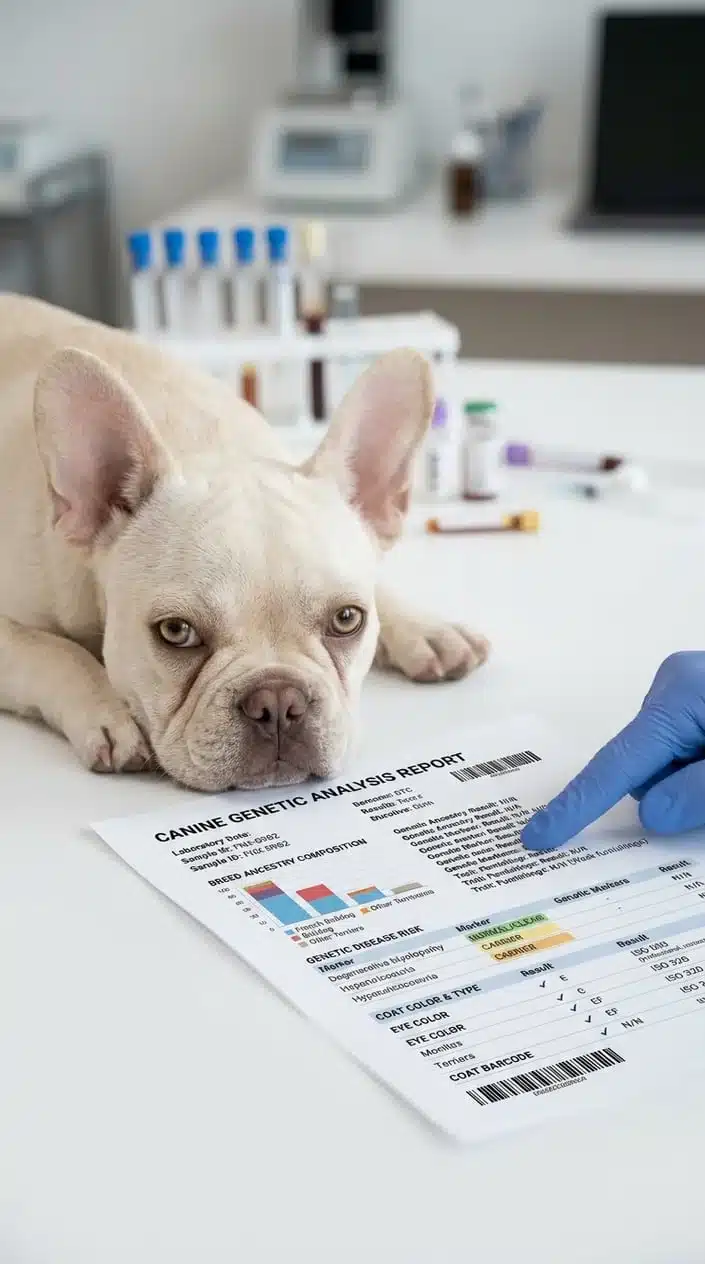
The E Locus and Recessive Cream
The E locus provides the Cream-looking foundation in the definitions most commonly used for Platinum Frenchies. The dog usually has e/e, so dark eumelanin is not expressed across most of the coat hair.
The D Locus and Dilution
Expressed D-locus dilution affects eumelanin. Black-based pigment becomes blue-gray, while brown pigment becomes a paler diluted brown.
Several variants in MLPH can be involved. A laboratory report should show which D-locus variants were tested instead of reducing the result to the single word “dilute.” The UC Davis dilution test provides a useful overview.
The B Locus and Brown Pigment
The B locus includes variants in TYRP1 associated with brown eumelanin. Our Chocolate French Bulldog guide explains how B-locus brown and Cocoa differ. When expressed, they can change black pigment to brown, including visible pigment on the nose and paw pads.
Under one common breeder convention, a Cream dog with expressed dilution and B-locus brown may be called an Isabella Platinum.
The French Bulldog Cocoa Variant
French Bulldogs also have a separately testable Cocoa variant associated with brown pigment. Cocoa is not simply another name for every B-locus result.
Under another common convention, an e/e dog expressing dilution and Cocoa may be called a Lilac Platinum. Some breeders use Lilac and Isabella differently, while others overlap the names.
How These Loci Interact
The visible Cream coat, pigment modification, and breeder label come from different genetic questions. This is why a complete report matters more than a single color name.
| Common Label | Frequently Claimed Shorthand | Important Limitation |
|---|---|---|
| Cream | e/e | The underlying pigment results can vary |
| Champagne | Often e/e + d/d | Informal definition; usage differs between breeders |
| Lilac Platinum | Often e/e + d/d + co/co | Not a universally enforced definition |
| Isabella Platinum | Often e/e + d/d + b/b | The B-locus variants tested should be named |
| New Shade Platinum | Often e/e + d/d + b/b + co/co | Marketing terminology, not a separate kennel-club color |
The shorthand above reflects common Frenchie marketing usage, not an official genetic naming standard. Our Blue vs. Lilac vs. Isabella French Bulldog comparison explains why the brown-and-dilution labels overlap.
Is Platinum a Real French Bulldog Color?
The genetic combinations described by Platinum listings can be real and testable. However, “Platinum” itself is not a standardized scientific result or a controlled kennel-club color term.
Laboratories report alleles at specific loci. They do not all issue a universally defined Platinum classification, and breeder communities do not agree on one required genotype.
The most accurate approach is to separate four things:
- Phenotype: What the dog visibly looks like
- Genotype: The variants shown on its DNA report
- Breeder label: The name used in an advertisement
- Breed-standard status: Whether the visible dog meets a kennel club’s conformation rules
Platinum vs. Cream French Bulldog
Both dogs can have nearly identical Cream-to-ivory coats. The claimed difference is the additional expressed pigment genetics beneath that appearance.
| Feature | Standard Cream Tendency | Platinum Label Tendency |
|---|---|---|
| Visible coat | Cream to ivory | Cream, ivory, or nearly white |
| Nose pigment | Usually black under the American standard | May be blue-gray, pale brown, taupe, or pinkish-brown |
| Lips and eye rims | Usually dark | May show diluted or brown-modified pigment |
| Paw pads | Usually dark | May be diluted or brown-toned |
| D-locus result | May vary | Usually expressed dilution under common definitions |
| B-locus/Cocoa result | May vary | Often expressed brown or Cocoa under narrower definitions |
| Photo reliability | Appearance offers clues | Cannot confirm the hidden genotype |
Cream describes the visible e/e phenotype. Platinum attempts to describe additional expressed dilution and brown-associated genetics beneath that Cream appearance.
Read our complete Cream French Bulldog guide for Cream vs. White, pale Fawn, and pigment identification.
Platinum vs. Champagne French Bulldog
Champagne is another informal term without one enforced definition. Some breeders use it for an e/e Cream dog that also expresses dilution but does not express the brown combination they require for Platinum.
Other sellers use Champagne more broadly or treat it as interchangeable with Platinum. Neither label replaces the E-locus, D-locus, B-locus, and Cocoa results.
Platinum vs. White or Pied French Bulldog
Cream hair contains pale pheomelanin, while the white areas of a Pied dog result from white spotting where pigment is absent from the hair. These are different biological mechanisms even when both dogs look nearly white in a photograph.
A Pied Frenchie usually has distinct colored patches separated by white. An extreme Pied dog may have so little visible color that it can be confused with Cream or Platinum.
Nose pigment and patch boundaries can help, but DNA and pedigree context may still be needed. Our Pied French Bulldog guide explains the pattern in detail.
Is a Platinum French Bulldog Albino?
No. Platinum is not another word for albinism.
Platinum generally describes a Cream phenotype combined with underlying pigment variants. Albinism involves a different disruption of pigment production and should not be diagnosed from a pale coat, light eyes, or a pink-looking puppy nose.
A veterinarian and an appropriate genetic test are needed when albinism is genuinely suspected.
Types of Platinum French Bulldogs
Names placed before Platinum usually describe additional claimed traits. They do not create separate French Bulldog breeds.
Blue Platinum
This usually means Cream masking expressed D-locus dilution. The Blue French Bulldog guide explains how dilution changes black-based pigment. Some breeders call the Cream-masked combination Champagne, which shows why the exact report is essential.
Lilac Platinum
This commonly refers to Cream masking dilution plus Cocoa-associated brown pigment. Compare the terminology with our Lilac French Bulldog guide. Usage is not universal, so request the Cocoa and B-locus results.
Isabella Platinum
This commonly refers to Cream masking diluted B-locus brown. See our Isabella French Bulldog guide for the appearance and DNA distinctions. The exact TYRP1 alleles tested should be visible on the report.
New Shade Platinum
This is commonly marketed as Cream combined with dilution, B-locus brown, and Cocoa. “New Shade” is breeder terminology rather than a new locus or official color.
Platinum Pied
Pied white spotting is a separate pattern. Cream can make colored areas difficult to distinguish, so the pattern and pigment results should be assessed separately.
Platinum Merle
Merle is another independent pattern. Cream may hide visible mottling, making an original M-locus report and documented parentage especially important.
Fluffy Platinum
“Fluffy” describes inherited longer coat length, not a color. A longer-coated Frenchie can also have the genetic combination marketed as Platinum.
How to Identify a Platinum French Bulldog

Examine the Coat in Neutral Daylight
Look for an even Cream, ivory, or eggshell coat without relying on a filtered listing photo. Daylight reduces some color casts but still cannot reveal hidden genetics.
Check the Nose, Lips, and Eye Rims
Blue-gray, pale brown, taupe, or muted pigment may support a claim that the dog expresses dilution or brown-associated variants. A partly pink, unpigmented area is not the same as genetically diluted pigment.
Look at the Paw Pads
Paw-pad pigment may match the diluted or brown tone visible around the face. Dirt, age, and uneven pigmentation can make this clue unreliable.
Review Puppy and Adult Photographs
Puppy coats and pigment can change as the dog matures. Compare unedited photographs taken in similar neutral lighting rather than expecting one early photo to predict the adult shade.
Do Not Use Eye Color as Proof
Blue, gray, greenish, hazel, or amber eyes can appear with overlapping color phenotypes. Puppy eye color can change, and Merle can affect eye pigmentation independently.
Request the Original DNA Report
The original report should identify the dog, testing laboratory, loci, alleles, and date. A cropped graphic that says only “Platinum” does not document the genotype.
| Visible Clue | What It May Suggest | Reliability |
|---|---|---|
| Pale Cream or ivory coat | An e/e Cream phenotype | Moderate |
| Cool blue-gray nose | Expressed dilution of black-based pigment | Moderate clue only |
| Pale brown or taupe nose | Brown-associated pigment plus possible dilution | Moderate clue only |
| Light eyes | Several possible color or pattern influences | Low |
| Silver sheen in photos | Often lighting, grooming, or camera processing | Very low |
| Complete allele-level DNA report | The tested genotype | High for included variants |
Why Photographs Can Be Misleading
The same Frenchie may look white, yellow-Cream, silver, or beige in different images. Visual shifts can result from:
- White balance and exposure
- Warm indoor bulbs or cool LED lighting
- Filters and automatic camera processing
- Reflected color from walls, grass, bedding, or clothing
- Sun fading and coat condition
- A wet coat or grooming products
- Puppy coat development
A metallic or silver sheen is not a genetic test. Coat shine says more about light, coat condition, and image processing than it does about the dog’s alleles.
What DNA Results Should You Request?
- The complete E-locus result, including whether the dog is e/e
- The D-locus variants included in the laboratory’s panel
- The exact B-locus alleles tested
- The separate French Bulldog Cocoa result
- The M-locus result when Merle is possible
- White-spotting results when Pied is relevant
- The dog’s identifying information on the original report
- A clear explanation of expressed variants versus carrier status
Request the allele-level laboratory report. A breeder-made color chart or screenshot that only says “Platinum” cannot show which variants were tested or whether they are expressed.
The UC Davis French Bulldog coat-color panel illustrates how E-locus Cream, D-locus dilution, B-locus brown, Cocoa, and other traits are reported separately.
Is Platinum an AKC-Recognized Color?
Platinum is not an official color term in the AKC French Bulldog breed standard. Cream is included in the American standard, but visible diluted, Liver-associated, unpigmented, or other disqualifying features can affect conformation eligibility.
Registration and show acceptance are different. A dog may receive registration paperwork without “Platinum” becoming an accepted conformation color.
| Organization | Relevant Standard | Platinum Status |
|---|---|---|
| AKC/FBDCA | Recognizes described colors including Cream; disqualifies colors and features outside the standard | Not an official color name; eligibility depends on the dog’s visible color and pigment |
| Royal Kennel Club | Lists Brindle, Fawn, and Pied as the correct colors | Not a correct color term |
| FCI | Permits Fawn, Brindled or not, with or without white spotting; disqualifies Mouse Gray and Brown | Not a recognized standard term |
Review the French Bull Dog Club of America color guidance and the relevant kennel-club standard when show eligibility matters.
Are Platinum French Bulldogs Rare?
A multilocus combination involving Cream, expressed dilution, and expressed brown-associated variants is less common than an ordinary Cream phenotype. However, no reliable population database establishes a precise percentage for Platinum Frenchies.
Availability, asking price, and phrases such as “one of one” do not prove genetic rarity. The exact DNA results are more informative than a seller’s rarity claim.
Calling Platinum “the rarest dog in the world” is unsupported. It is one informally named color combination within one breed.
Do Platinum French Bulldogs Cost More?
They are often advertised at a premium, but there is no official or stable Platinum price. Cost varies with location, pedigree, demand, sex, coat length, pattern, breeding rights, and the breeder’s reputation.
A high price does not prove that the color label is accurate or the puppy is responsibly bred. Compare documented health screening, structure, breathing, temperament, contract terms, and lifetime support before comparing color premiums.
Does Platinum Coloring Affect Health?
Platinum is not a health diagnosis. Cream, dilution, brown pigment, Pied, and Merle are separate genetic questions and should not be grouped into one blanket health claim.
Some dogs expressing MLPH-related dilution can develop color dilution alopecia. Possible signs include brittle hair, thinning, patchy hair loss, scaling, or recurrent skin trouble, but not every dilute dog is affected.
A color-panel result cannot diagnose alopecia. A veterinarian should assess hair loss or inflamed skin and rule out allergies, parasites, infection, hormonal disease, and other causes.
Breed-wide concerns remain more important, including brachycephalic obstructive airway syndrome, heat intolerance, spinal disease, patellar problems, eye disorders, heart disease, and skin-fold irritation.
Color DNA confirms pigment variants. It does not measure airway function, spinal health, joint soundness, cardiac health, eye health, or responsible breeding quality.
Does Platinum Affect Size or Temperament?
No reliable evidence supports a special Platinum size or personality. Platinum Frenchies are not inherently smaller, calmer, less aggressive, more affectionate, or easier to train.
Adult size depends on broader genetics, sex, development, nutrition, and health. Behavior depends on the individual dog, parental temperament, socialization, learning history, environment, and physical comfort.
What to Ask Before Buying a Platinum Frenchie
- What exact genotype does “Platinum” mean in this listing?
- Can I review the original color-panel report?
- Which D-locus variants were tested?
- Were both B-locus brown and Cocoa tested?
- Is the dog Cream, Pied, Merle, or a combination?
- Which variants are expressed, and which are only carried?
- What breed-wide health screenings were completed on both parents?
- Can the results be verified through the laboratory or a public health database?
- What airway, spinal, joint, skin, eye, or cardiac problems occurred in close relatives?
- Is the price based mainly on color terminology?
Platinum French Bulldog Care
A Platinum Frenchie needs the same core care as other French Bulldogs. Keep the dog lean, avoid strenuous activity in heat and humidity, and monitor breathing during walks and play.
Brush the coat weekly and keep facial folds and ears clean and dry. Light coats may show dirt, tear staining, redness, or sun irritation more easily, but harsh whitening products can irritate the skin.
Do not use human sunscreen, essential oils, or stain-removing products without veterinary guidance. Seek prompt veterinary care for labored breathing, collapse, blue or gray gums, eye pain, severe itching, or sudden hair loss.
Frequently Asked Questions
What Makes a French Bulldog Platinum?
Platinum commonly means an e/e Cream Frenchie that also expresses dilution and, under narrower definitions, B-locus brown, Cocoa, or both. The term is informal, so the exact genotype must be stated.
Is Platinum the Same as Cream?
Not exactly. Cream describes the visible e/e phenotype, while Platinum attempts to describe additional underlying pigment variants beneath that Cream appearance.
Is Platinum the Same as Champagne?
Not under every breeder convention. Champagne often means Cream plus dilution without the brown combination required by some Platinum definitions, but both terms are used inconsistently.
What DNA Makes a Platinum Frenchie?
There is no universally required formula. Common definitions start with e/e and add expressed dilution, plus B-locus brown, Cocoa, or both.
What Is a Lilac Platinum French Bulldog?
It commonly means Cream masking dilution and Cocoa-associated brown pigment. Ask for the separate E, D, Cocoa, and B-locus results because naming conventions differ.
What Is an Isabella Platinum French Bulldog?
It commonly means Cream masking diluted B-locus brown. The original report should identify the specific B-locus and D-locus variants tested.
What Is a New Shade Platinum French Bulldog?
Breeders commonly use this phrase for Cream combined with dilution, B-locus brown, and Cocoa. It is a marketing label, not a separate locus or kennel-club color.
Can You Identify Platinum From a Photograph?
No. Photos may show a pale coat and diluted pigment, but lighting, filters, age, and overlapping phenotypes prevent confident genetic classification.
Do Light Eyes Prove a French Bulldog Is Platinum?
No. Eye color can overlap across several phenotypes, can change after puppyhood, and may be influenced separately by Merle.
Do Platinum French Bulldogs Have Pink Noses?
Some have pale brown or pinkish-brown diluted pigment. A truly unpigmented pink area is different, and nose color alone cannot prove the complete genotype.
Are Platinum Frenchies Albino?
No. Platinum and albinism describe different pigment mechanisms. A pale coat, light eyes, or pink-looking nose is not enough to diagnose albinism.
Is Platinum Recognized by the AKC?
No. Platinum is not an official AKC color name, and registration paperwork does not automatically make the visible color or pigment acceptable for conformation.
Are Platinum French Bulldogs Unhealthy?
Not automatically. Expressed dilution may be relevant to color dilution alopecia in some dogs, but breed-wide health screening matters far more than the marketing label.
Do Platinum Frenchies Have a Different Temperament?
No established evidence shows a Platinum-specific temperament. Judge the dog’s parents, socialization, health, behavior, and individual personality.
Can a Platinum Frenchie Also Be Pied, Merle, or Fluffy?
Yes. Pied and Merle are separate patterns, while Fluffy describes coat length. These traits can occur alongside a Cream-masked pigment combination.
Final Takeaway
Platinum is best understood as an informal label for a Cream French Bulldog with additional underlying dilution and usually brown-associated genetics. Because definitions vary, the original E-locus, D-locus, B-locus, and Cocoa results are more reliable than coat shade, eye color, price, or a breeder’s label.
Choose a Frenchie for functional health, sound structure, manageable breathing, stable temperament, and transparent breeding records. Color can be a preference, but it should never outrank the qualities that shape the dog’s daily comfort and long-term well-being.


![Do French Bulldogs Have Breathing Problems [Clarified]](https://onlyfrenchbulldog.com/wp-content/uploads/2024/06/do-french-bulldogs-have-breathing-problems-clarified_3202.jpg.webp)
![What Are French Bulldogs Bred For [Answered]](https://onlyfrenchbulldog.com/wp-content/uploads/2024/06/what-are-french-bulldogs-bred-for-answered_3194.jpg.webp)