Merle French Bulldog: Genetics, Colors, Health and Identification

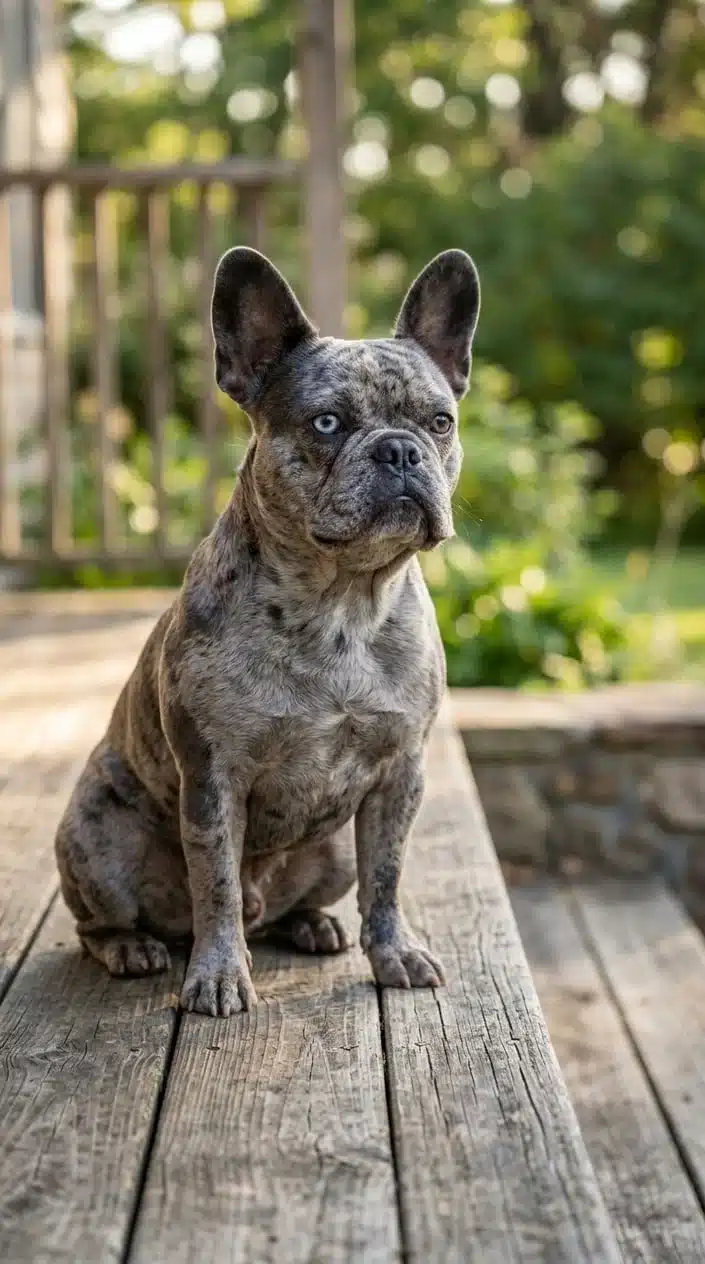
A Merle French Bulldog has irregular lighter and darker patches that create a marbled or mottled coat. Merle is a pattern layered over the dog’s underlying color, not a separate French Bulldog breed or a single color.
The pattern can look striking, but appearance is only part of the story. Prospective owners also need to understand merle genetics, double-merle health risks, DNA testing, breed-standard status, and the health screening every Frenchie breeder should provide.
- Merle creates random mottled patches by altering pigment distribution in the coat.
- A visible pattern alone cannot always confirm genotype because some merle variants are subtle or hidden.
- A dog with one merle copy is different from a double merle that inherits a merle variant from both parents.
- Merle-to-merle breeding can produce double-merle puppies with a much higher risk of hearing and eye abnormalities.
- Merle is a disqualifying pattern under the AKC French Bulldog breed standard.
- Coat color does not determine a Frenchie’s personality, adult size, or quality as a companion.
What Is a Merle French Bulldog?
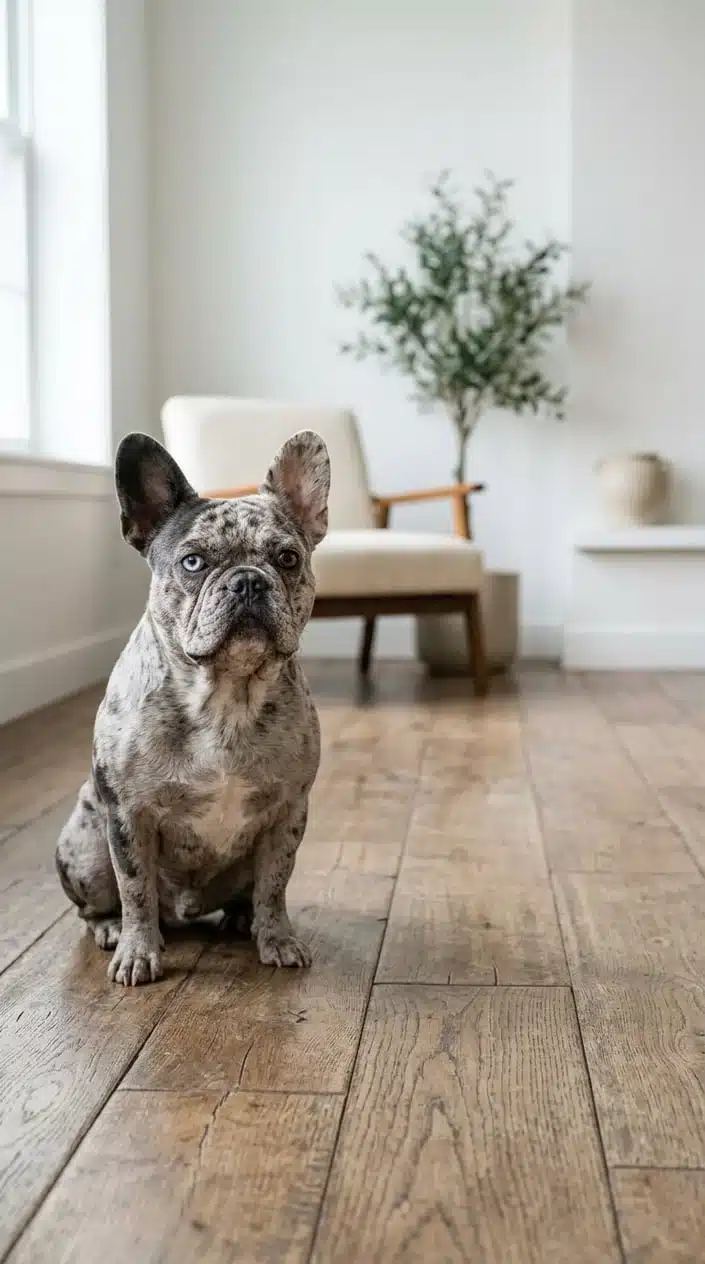
A Merle French Bulldog is a Frenchie with a merle-associated variant of the PMEL gene, historically called SILV. That variant changes how eumelanin, the dark pigment in hair, is distributed across parts of the coat.
The result is an uneven pattern of full-strength pigment and lighter areas. Depending on the base color and other genes, the coat may appear gray and black, brown and tan, muted lilac, or faintly mottled over fawn.
Merle does not create a new temperament or body type. A merle Frenchie is still expected to have the companion-oriented personality, compact build, exercise needs, and brachycephalic care requirements associated with French Bulldogs.
How to Identify the Merle Pattern
Look for irregular patches with jagged or marbled edges rather than even stripes or clean white areas. The distribution is random, so the two sides of the dog may look very different.
- Coat: Mottled, dappled, or marbled areas with darker patches remaining over lighter pigment.
- Eyes: Brown, blue, partly blue, or two different colors may occur, but blue eyes alone do not prove merle.
- Nose and paw pads: Pigment may be solid or patchy.
- Pattern strength: Some dogs show bold patches, while others show only a small merled area.
Visual identification has limits. Cream, fawn, heavy white spotting, and very small merle patches can hide the pattern, so a DNA result is more reliable than a photograph or breeder label.
Free French Bulldog Care Tips Every Week!
Health, feeding, training and Frenchie secrets — straight to your inbox, completely free!
🔒 No spam. Unsubscribe anytime.
Merle vs. Brindle vs. Pied
| Pattern | What You Usually See | Main Difference |
|---|---|---|
| Merle | Random marbling with lighter and darker pigment | Irregular mottled patches |
| Brindle | Dark stripes over a fawn background | Striped rather than marbled |
| Pied | Large white areas with defined colored patches | White spotting with clearer patch borders |
A very dark brindle French Bulldog can look almost black, but close inspection usually reveals fine fawn striping. A pied French Bulldog may also carry colored patches, but pied and merle are genetically different patterns.
How Merle Genetics Work
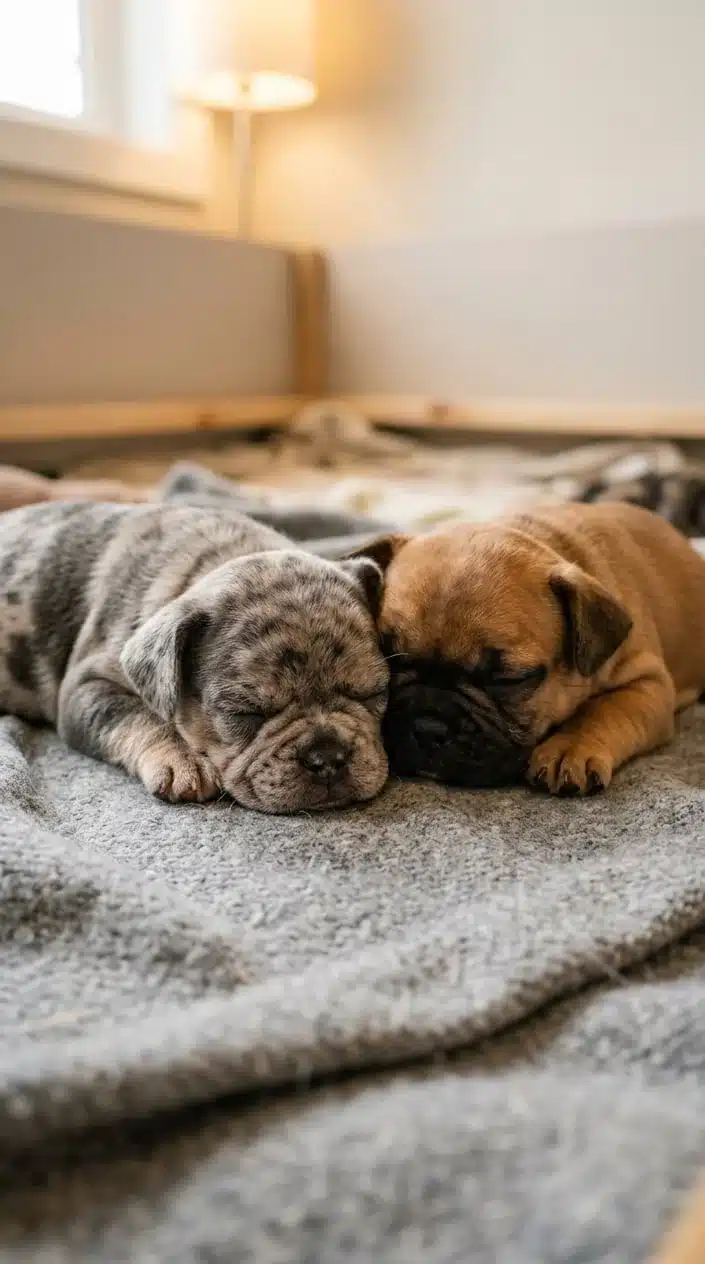
Merle is associated with a SINE insertion in the PMEL gene at the M locus. In simple terms, a dog can inherit a merle-associated allele from either parent, and one copy can be enough to alter the coat.
Real-world merle genetics are more complex than a basic “M or m” chart. The length and stability of the inserted sequence can influence whether the pattern is bold, subtle, cryptic, or mosaic, which is why modern DNA reports may identify several merle alleles rather than only two.
Single Merle and Double Merle
| Genetic Situation | Meaning | Practical Concern |
|---|---|---|
| Non-merle | No merle-associated allele detected | Cannot pass a merle allele unless a test misses a complex variant |
| Single merle | One merle-associated allele | May show a visible, faint, or hidden pattern |
| Double merle | Merle-associated alleles inherited from both parents | Substantially greater risk of congenital eye and hearing abnormalities |
Using the simplified model, mating a single-merle dog with a confirmed non-merle dog is expected to produce about 50% merle and 50% non-merle puppies over many litters. Each puppy’s result is independent, so a small litter may not match that ratio.
If two single-merle dogs are paired, each puppy has an approximate 25% chance of inheriting two merle copies, 50% chance of inheriting one, and 25% chance of inheriting neither. This preventable double-merle outcome is why merle-to-merle breeding is strongly discouraged.
Never rely on coat appearance alone when planning a mating. A cryptic or minimally expressed merle can look non-merle, so both parents require appropriate DNA testing interpreted by a knowledgeable professional.
Cryptic and Mosaic Merle
“Cryptic,” “atypical,” “minimal,” and “mosaic” are sometimes used loosely in advertisements. They do not all mean exactly the same genetic result, and laboratories may use different reporting systems.
A minimally patterned dog may carry a merle-associated allele even when only a few hairs look mottled. Mosaicism means different cells may carry different merle repeat lengths, which can complicate appearance and inheritance predictions.
For a broader explanation of how pigment genes interact, see our French Bulldog color genetics guide.
Merle French Bulldog Health Risks
The most important distinction is between breed-wide French Bulldog conditions and risks associated with particular merle genotypes. Merle does not cause every breathing, spinal, skin, joint, or allergy problem seen in a Frenchie.
All French Bulldogs can be affected by brachycephalic obstructive airway syndrome, heat intolerance, spinal disease, eye injuries, skin-fold problems, and orthopedic conditions. Selecting for a fashionable coat does not replace screening for these much broader health concerns.
Why Double Merle Is a Serious Concern
Pigment-producing cells have roles beyond hair color, including normal development and function in parts of the inner ear and eye. Dogs with two merle-associated alleles have a higher risk of congenital deafness and structural eye abnormalities.
Possible problems include deafness in one or both ears, abnormally small eyes, malformed eye structures, and reduced vision. Severity varies, and not every double-merle dog has identical impairments, but knowingly creating the risk is avoidable.
The Royal Kennel Club’s merle guidance states that dogs inheriting merle from both parents have an increased risk of eye and ear problems. It does not register puppies produced from merle-to-merle matings.
Does a Single-Merle Frenchie Always Have Health Problems?
No. A single-merle result is not a diagnosis, and a healthy-looking coat cannot predict the dog’s complete medical future.
However, buyers should not accept the opposite claim that “single merle means completely risk-free.” Individual genotype, white patterning, family history, testing quality, and the French Bulldog’s existing health burden all matter.
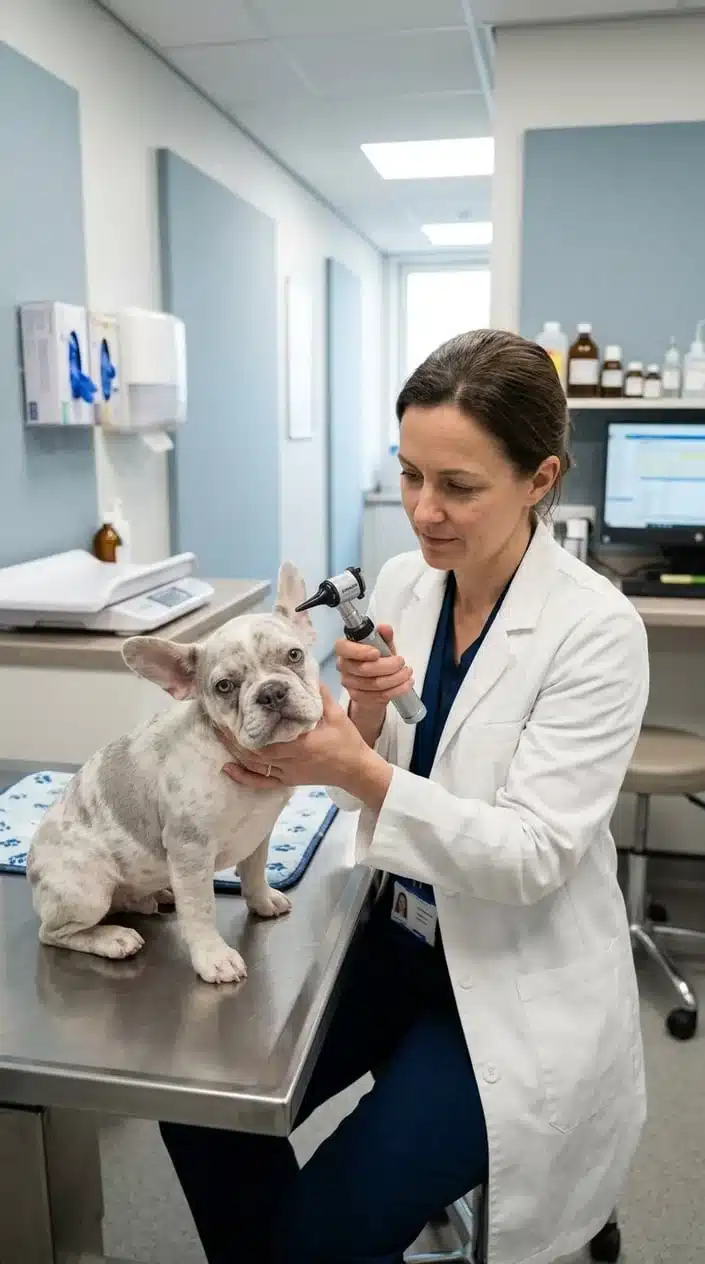
Ask whether puppies receive a veterinary eye examination and a BAER hearing test. BAER testing can detect deafness in one ear that may not be obvious during normal play.
If a puppy has very small eyes, unusual pupils, persistent squinting, poor response to sound, or an uncertain breeding history, arrange an examination promptly. A veterinarian may recommend a veterinary ophthalmologist or BAER hearing assessment.
Merle Colors and Common Marketing Names
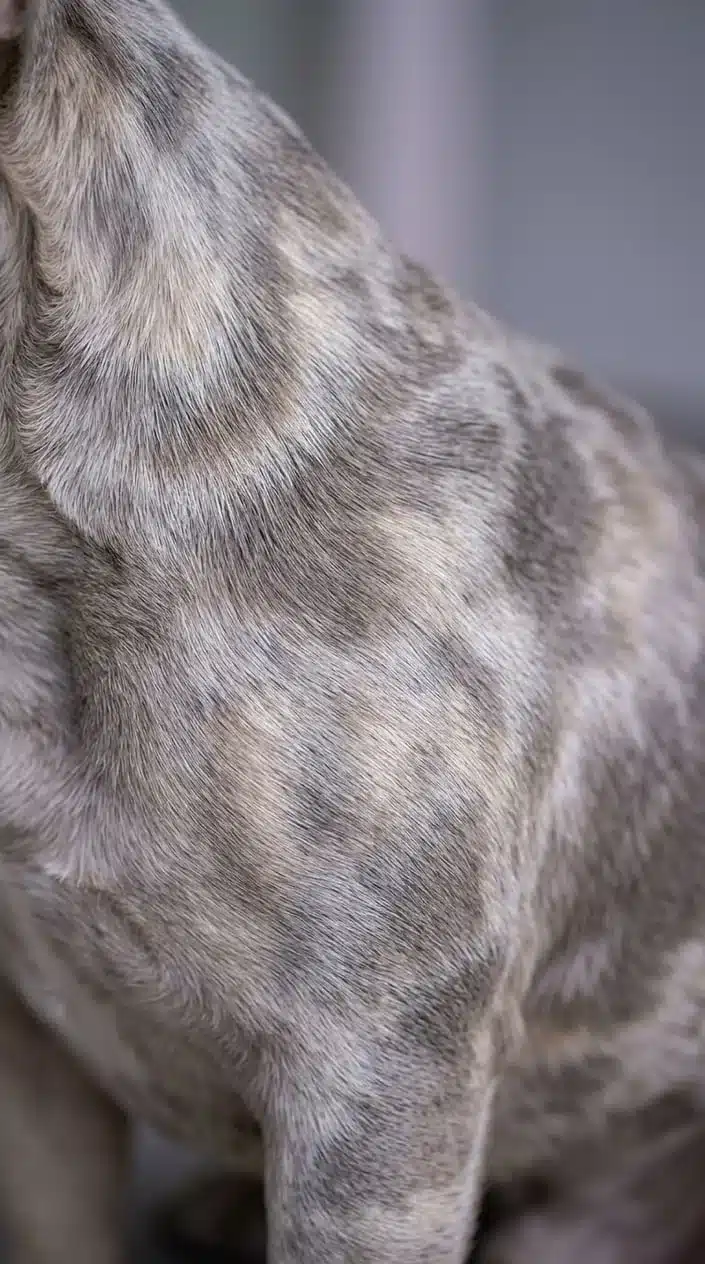
Merle modifies the pigment a dog already has, so labels such as blue merle or lilac merle combine a base-color description with the pattern. Breeder terminology is inconsistent, and similar-looking puppies may receive different sales labels.
| Common Label | Typical Appearance | Important Note |
|---|---|---|
| Blue merle | Black areas broken by gray or slate mottling | Often confused with a genetically dilute blue base |
| Chocolate merle | Brown pigment with lighter brown or tan marbling | Brown nose pigment can help distinguish it from black-based merle |
| Lilac or Isabella merle | Muted taupe, silvery beige, or lavender-gray areas | Names are used inconsistently; DNA verification matters |
| Fawn merle | Fawn coat with visible or subtle mottling | Pattern may be difficult to see on pheomelanin-rich hair |
| Pied merle | White spotting plus merled colored patches | Pied and merle are two separate patterns occurring together |
| Fluffy merle | Merle pattern on a longer coat | “Fluffy” describes hair length, not a merle subtype |
A standard photograph cannot reliably separate every combination. Compare our guides to the Blue French Bulldog, Lilac French Bulldog, and Isabella French Bulldog before accepting a rare-color label.
Long hair is controlled separately from merle. Our guide to the blue merle fluffy French Bulldog explains how those two traits can appear together.
AKC Status, Rarity and Price
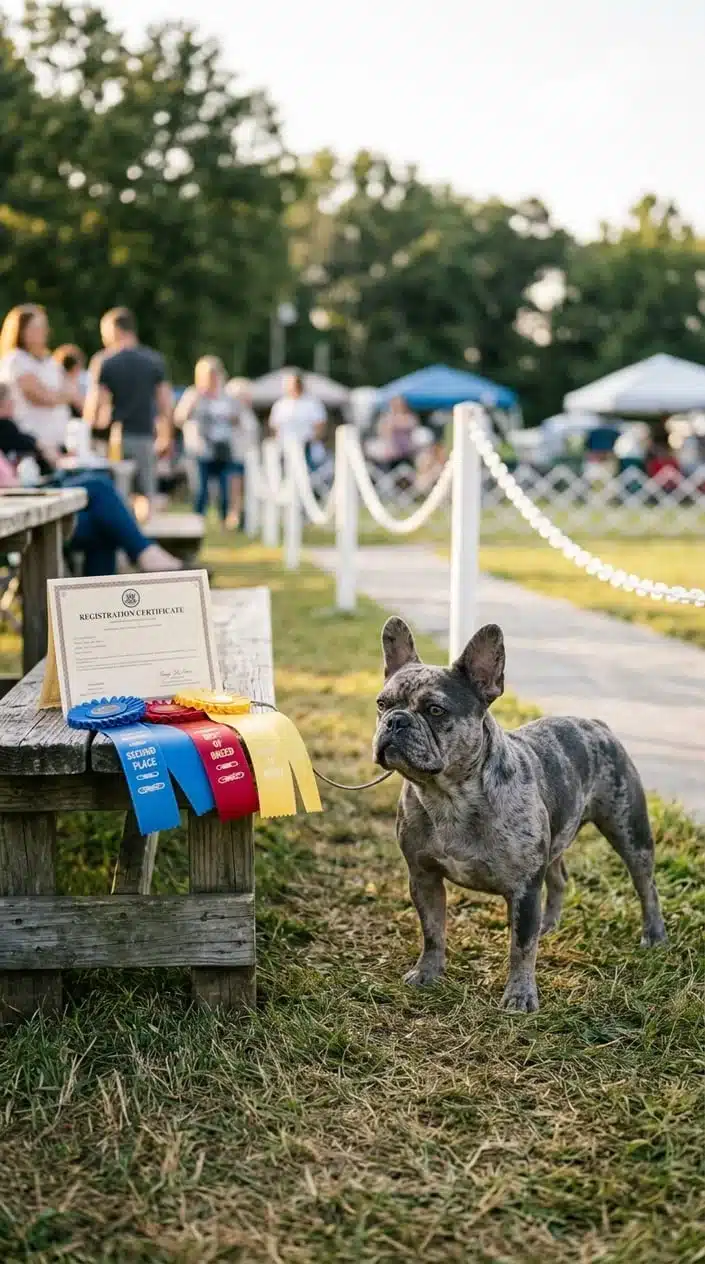
Merle is explicitly disqualifying under the American French Bulldog breed standard. A merle Frenchie cannot compete as a conforming example of the breed in AKC conformation, even if paperwork exists for the dog.
AKC registration and breed-standard acceptance are not the same thing. Registration records parentage and entry in the registry; it does not certify that a dog has an accepted color, ideal structure, or good health.
The French Bull Dog Club of America advises buyers against colors and patterns excluded by the standard. Buyers should understand this position before paying a premium for a “rare” Frenchie.
Are Merle French Bulldogs Rare?
Merle is less common than standard fawn, cream, brindle, and pied coats, but “rare” is mainly a marketing description. Availability can change quickly when breeders intentionally select for a profitable appearance.
Rarity does not prove purity, health, or quality. The merle pattern is not historically accepted in the French Bulldog breed standard, and claims about exactly when or how it entered particular bloodlines are difficult to verify without complete pedigree and genomic evidence.
How Much Does a Merle French Bulldog Cost?
Merle puppies are commonly advertised for several thousand dollars, and combinations marketed as lilac, Isabella, fluffy, or “new shade” may cost much more. Prices vary by location, demand, age, breeder, and claimed color genetics.
A high price does not prove responsible breeding, while a suspiciously cheap puppy may signal missing health tests or an online scam. Our separate guide examines the price of a Merle French Bulldog in more detail.
How to Choose a Merle French Bulldog Responsibly
Start with health and temperament, not coat color. A breeder should be willing to show original test reports, explain both parents’ results, discuss limitations honestly, and let you see how the puppies are raised.
Ask for These Records
- Merle-locus DNA results for both parents from an established laboratory.
- Proof that the litter did not come from a merle-to-merle pairing.
- Breed-appropriate cardiac, patellar, hip, eye, and airway-related evaluations.
- A veterinary examination for each puppy.
- BAER hearing results, especially for merle puppies or puppies with extensive white around the head.
- A written contract, health terms, return policy, and permanent identification details.
DNA color testing alone is not comprehensive health testing. A breeder can correctly identify the coat genes and still ignore breathing, spine, heart, patella, eye, or temperament problems.
Our guide to finding an ethical dog breeder provides a fuller checklist for verifying records and spotting pressure tactics.
Red Flags to Walk Away From
- Both parents are advertised as merle.
- The seller refuses to provide complete laboratory reports.
- The puppy’s unusual color is the main sales pitch.
- The seller promises that color DNA proves the puppy is healthy.
- You are pressured to send a deposit before verifying the dog and seller.
- Photos appear on several websites or cannot be matched to a live video call.
- The breeder claims blue eyes prove a puppy is merle or “rare.”
The safest puppy is not the one with the most unusual color label. Prioritize open nostrils, comfortable movement, sound temperament, documented health screening, and a breeder who remains responsible for every dog produced.
Caring for a Merle French Bulldog
A single-merle Frenchie does not need a completely different daily routine simply because of its pattern. Care should address the individual dog’s hearing, vision, skin pigmentation, and the needs shared by all flat-faced French Bulldogs.
- Keep exercise short and moderate, especially in warm or humid weather.
- Use a harness and watch for noisy breathing, slow recovery, or heat stress.
- Clean and dry facial folds according to your veterinarian’s advice.
- Protect lightly pigmented skin from excessive sun exposure.
- Schedule routine eye, ear, dental, weight, and mobility checks.
- Use visual or hand-signal training if hearing is reduced.
Color does not change the typical Frenchie personality. Socialization, genetics beyond coat color, early handling, training, pain, and the home environment have far more influence on behavior.
Frequently Asked Questions
Is Merle a French Bulldog Color or Pattern?
Merle is a coat pattern, not one standalone color. It creates irregular lighter areas within eumelanin-based pigment and can appear alongside different base colors and white spotting.
Can Two Non-Merle French Bulldogs Produce a Merle Puppy?
Under a simple inheritance model, a puppy needs a merle-associated allele from a parent. If both parents look non-merle, testing may reveal minimal expression, cryptic variants, mosaicism, incorrect parentage, or an inaccurate visual label.
Are All Blue-Eyed French Bulldogs Merle?
No. Blue eyes can occur for reasons other than merle, including extensive white patterning and other genetic influences. Eye color alone cannot confirm the merle genotype.
Can a Merle French Bulldog Be AKC Registered?
Registration and conformation eligibility are different. Merle is a disqualifying pattern in the AKC French Bulldog standard, so paperwork should never be presented as proof that merle is an accepted show pattern.
Do Merle French Bulldogs Have a Shorter Lifespan?
There is no dependable separate lifespan figure for every merle Frenchie. Longevity depends on overall breeding quality, airway health, spine and heart conditions, weight, veterinary care, and whether the dog has merle-related sensory abnormalities.
What Is the Safest Way to Confirm a Merle Frenchie?
Use a reputable canine DNA laboratory and have the result interpreted alongside the coat, pedigree, and parental results. For health, DNA color testing should be combined with veterinary eye and hearing assessments and full breed-appropriate screening.
Final Takeaway
A Merle French Bulldog can be a loving companion, but the marbled coat deserves informed scrutiny rather than automatic admiration or fear. Single merle and double merle are not interchangeable, and responsible decisions begin with accurate testing.
Before buying, verify both parents, rule out merle-to-merle breeding, review full health records, and understand that merle falls outside the AKC breed standard. The best choice is always the dog whose health and welfare were valued above color and price.