
What Is a Chocolate French Bulldog? Genetics, Colors and Identification


A Chocolate French Bulldog has brown pigment where a typical Frenchie would have black pigment. That change can affect the coat, nose, lips, eye rims, and paw pads, but the word “Chocolate” does not describe one single genotype.
Some Chocolate Frenchies inherit brown variants at the B locus, while others inherit the French Bulldog-associated Cocoa variant. Because breeder labels are not always used consistently, appearance alone cannot confirm which genetic pathway produced the color.
- A Chocolate French Bulldog is a French Bulldog with brown rather than black eumelanin pigment.
- Brown coloring may come from
TYRP1variants at the B locus or the Cocoa variant inHPS3. - A brown nose, lips, eye rims, and paw pads are stronger clues than coat color alone.
- “Cocoa,” “testable Chocolate,” and “Rojo” are breeder terms that are not always used consistently.
- A coat-color DNA panel can identify tested variants, but it does not prove that a dog is healthy.
- Chocolate is not an accepted French Bulldog conformation color under the AKC breed standard.
What Is a Chocolate French Bulldog?

A Chocolate French Bulldog is not a separate breed or crossbreed. It is a purebred French Bulldog whose eumelanin—the pigment that normally appears black—looks brown.
This pigment change can be visible throughout a mostly brown coat or combined with patterns such as tan points, brindle, pied, or merle. A dog can therefore be Chocolate and Tan, Chocolate Pied, or Chocolate Merle without becoming a different type of breed.
Chocolate is also different from Cream. Cream affects how the coat is expressed and can hide other color genetics, while Chocolate changes the dark eumelanin pigment itself.
What Does a Chocolate Frenchie Look Like?
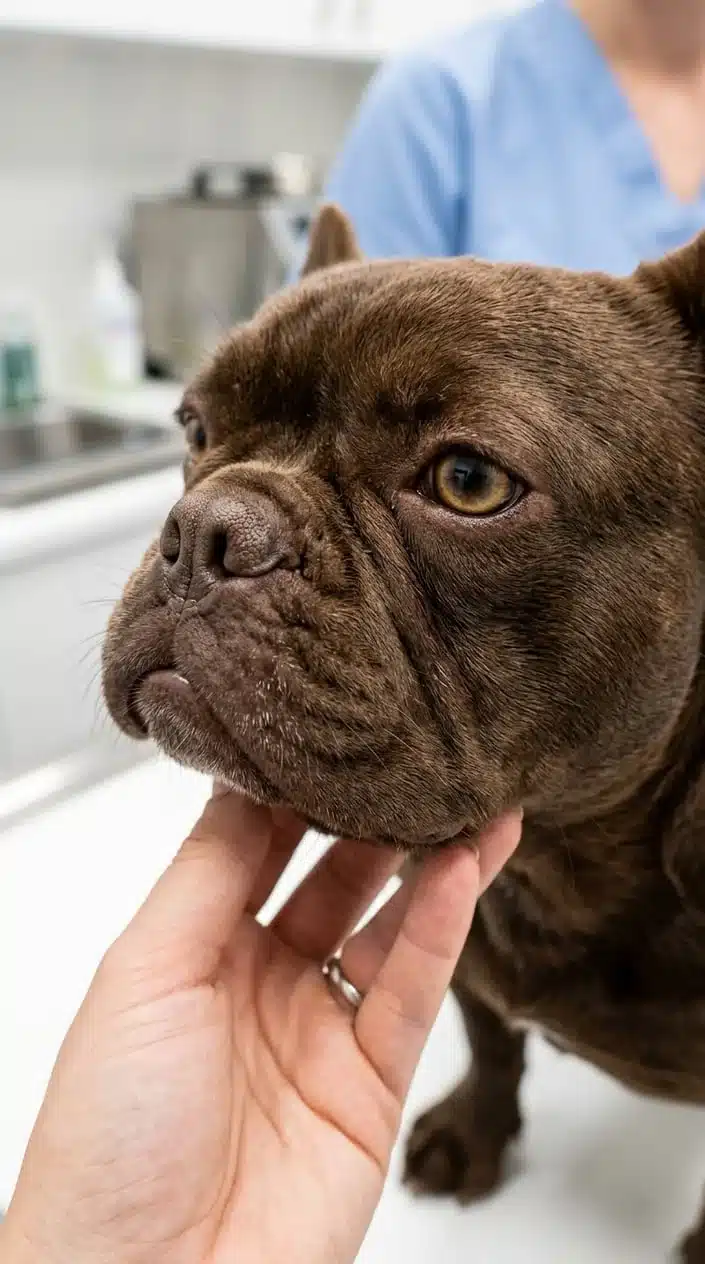
Chocolate Frenchies range from medium brown to deep, dark brown. Lighting, coat length, age, and the dog’s other color genes can all influence how warm, red, or muted the coat appears.
The most useful visual clue is not simply a brown-looking coat. Look at every area that would normally contain black pigment:
Free French Bulldog Care Tips Every Week!
Health, feeding, training and Frenchie secrets — straight to your inbox, completely free!
🔒 No spam. Unsubscribe anytime.
- Nose leather
- Lips
- Eye rims
- Paw pads
- Dark hairs in the coat
These areas usually appear brown on a Chocolate phenotype. The eyes may be amber, hazel, yellow-brown, greenish, or brown, but eye color alone cannot confirm the dog’s genetics.
| Feature | Possible Chocolate or Cocoa clue | Conclusive? |
|---|---|---|
| Coat pigment | Brown rather than true black | No |
| Nose | Brown or liver-colored | No |
| Lips and eye rims | Brown rather than black | No |
| Paw pads | Brown pigment | No |
| Eyes | Amber, hazel, or lighter brown | No |
| Flashlight or “red-eye glow” test | Informal breeder method | No |
| Coat-color DNA report | Identifies variants included in the panel | Yes, for those tested variants |
Chocolate French Bulldog Genetics Explained

Chocolate coloring can arise through more than one genetic pathway. The two most important for French Bulldogs involve the B locus and the Cocoa locus.
B-Locus Chocolate
The B locus involves the TYRP1 gene. Dogs with two copies of certain recessive brown variants produce brown rather than black eumelanin. Breeders have traditionally called this “testable Chocolate” because laboratories could identify common B-locus variants.
A dog with only one recessive B-locus variant is generally a carrier and may not look Chocolate. The exact result depends on the full pair of alleles and the other color genes the dog inherited.
Cocoa and the HPS3 Gene
Cocoa is associated with an autosomal-recessive variant in the HPS3 gene. A dog generally needs two copies of the Cocoa variant for the phenotype to be expressed.
The UC Davis Veterinary Genetics Laboratory explains that Cocoa is genetically distinct from the usual B-locus brown variants. A Frenchie may carry variants at one or both genetic areas, which is why a complete report is more useful than a color label.
Why “Non-Testable Chocolate” Is Outdated
Before a Cocoa DNA test became available, breeders often called the phenotype “non-testable Chocolate.” That phrase may still appear in older articles and advertisements, but Cocoa can now be tested.
“Testable Chocolate” is still commonly used for B-locus brown, yet it should not be interpreted to mean Cocoa is untestable. Current laboratory panels can include both B-locus Brown and Cocoa.
| Common label | Genetic area | Gene | What it generally affects |
|---|---|---|---|
| B-locus or “testable” Chocolate | B locus | TYRP1 |
Changes black eumelanin to brown |
| Cocoa | Co locus | HPS3 |
Produces a brown phenotype through a distinct pathway |
Chocolate vs. Cocoa vs. Rojo
These terms are easy to confuse because they mix visual descriptions, genetics, and breeder marketing language.
- Chocolate is the broad everyday description for brown pigment.
- Cocoa usually refers specifically to the recessive
HPS3variant found in French Bulldogs. - Rojo is an informal breeder term often used for a rich reddish B-locus Chocolate phenotype.
- Testable Chocolate traditionally refers to B-locus brown variants.
Rojo is not an official breed-standard color or a separate locus. Its meaning can vary between sellers, so request the actual laboratory report instead of relying on the name.
Can You Identify a Chocolate Frenchie Without DNA Testing?
You can recognize a likely Chocolate phenotype from its brown pigment, but you cannot reliably distinguish every B-locus and Cocoa combination by sight. Photos are particularly unreliable because sunlight, indoor bulbs, filters, and camera settings can change the apparent shade.
A full French Bulldog coat-color panel should include both B-locus Brown and Cocoa if you want to understand the source of the brown pigment. The UC Davis French Bulldog coat-color panel also illustrates how several loci work together to produce the final coat.
Confirm that the name or identification number on any DNA report belongs to the advertised puppy or its parents. A screenshot without identifying information is not meaningful proof.
Common Chocolate Colors and Patterns
Brown pigment can combine with other genes that control pattern, intensity, dilution, white spotting, and coat length.
Solid Chocolate
A mostly solid Chocolate Frenchie has an overall brown appearance, although a small amount of white may be present. “Solid” describes the visible pattern; it does not reveal whether the brown comes from B-locus variants, Cocoa, or both.
Chocolate and Tan
Chocolate and Tan Frenchies have brown base pigment with lighter tan points, commonly above the eyes, on the cheeks, chest, and legs. The tan-point pattern and brown-pigment genetics are inherited separately.
Chocolate Brindle and Chocolate Pied
Chocolate Brindle combines brown pigment with brindle striping. Chocolate Pied combines brown patches with larger white areas. Our Pied French Bulldog guide explains how the pied pattern differs from the underlying patch color.
Chocolate Merle
Chocolate Merle combines brown eumelanin with the merle pattern. Merle is a separate pattern gene and requires careful breeding decisions because mating two merle-patterned dogs can increase the risk of puppies with hearing, vision, and developmental problems.
Read our Merle French Bulldog guide for a fuller explanation of the M locus and double-merle risk.
Fluffy Chocolate
A Fluffy Chocolate Frenchie inherits long-coat variants as well as brown-pigment genetics. Coat length changes the texture and appearance, but it does not create the Chocolate color.
Chocolate vs. Blue, Lilac and Isabella French Bulldogs
A Blue French Bulldog has diluted black pigment that appears blue-gray. A Chocolate Frenchie has brown pigment without that visible blue-dilution effect.
When brown pigment is also diluted at the D locus, the coat may appear pale brown, taupe, gray-brown, or silvery. Sellers may market the result as Lilac or Isabella, although terminology can vary with the underlying brown variant and breeder convention.
Our guides to the Lilac French Bulldog and Isabella French Bulldog explain those combinations in more detail. When labels conflict, the DNA results provide clearer information than the advertised color name.
| Color label | Typical pigment appearance | Main distinction |
|---|---|---|
| Chocolate | Brown | Brown eumelanin through B-locus, Cocoa, or combined genetics |
| Blue | Blue-gray | Dilution of otherwise black eumelanin |
| Lilac or Isabella | Pale brown, taupe, or silvery | Brown pigment combined with dilution; naming varies |
| Platinum | Cream, ivory, or nearly white | Visible cream can mask underlying color genetics |
A Platinum French Bulldog may carry Chocolate or Cocoa-related variants even though its cream coat hides much of the underlying pigment pattern.
Are Chocolate French Bulldogs AKC Recognized?
“AKC recognized” can mean several different things. Registration, the color recorded on paperwork, and eligibility in a conformation show are not the same.
A French Bulldog may be eligible for AKC registration based on its registered parentage even when its color does not meet the conformation standard. However, liver—often called Chocolate by breeders and owners—is a disqualifying color under the French Bulldog breed standard.
The French Bull Dog Club of America’s color guidance explains the standard and disqualifying colors. Registration paperwork should never be treated as proof that a Chocolate coat is an accepted show color or that the dog has passed health testing.
Do Chocolate French Bulldogs Have More Health Problems?
Chocolate is a pigment description, not a medical diagnosis. A Chocolate Frenchie should not be assumed healthy or unhealthy solely because of its coat color.
UC Davis notes that effects beyond pigmentation have not been reported in Cocoa dogs and that it remains unknown whether the canine Cocoa variant has other effects. It is therefore inaccurate to claim either that Cocoa causes specific diseases or that it has been proven completely risk-free.
Every French Bulldog should be evaluated for breed-wide concerns, including:
- Brachycephalic obstructive airway syndrome and heat intolerance
- Spinal and mobility problems
- Hip and patellar problems
- Eye conditions
- Skin-fold irritation and infections
- Allergies and recurring ear or paw problems
Color-focused breeding can become risky when appearance is prioritized over breathing, structure, temperament, and genetic diversity. The breeder’s decisions and the parents’ health results matter far more than a premium color label.
Color Testing Is Not Health Testing
A coat-color test answers questions about pigmentation. It does not assess airway function, joint stability, heart health, eye health, spinal structure, or the puppy’s overall condition.
| Type of check | What it can tell you | What it cannot prove |
|---|---|---|
| Coat-color DNA panel | Tested color and pattern variants | That the dog is healthy |
| Parental health screening | Results for specific evaluated conditions | That a puppy will never develop a problem |
| Veterinary examination | Current breathing, mobility, skin, eyes, and general health | Every future health outcome |
For French Bulldog breeding stock, buyers should request verifiable hip, patella, cardiac, and eye evaluation results. These are included in the AKC’s breed-specific health-testing recommendations.
Chocolate French Bulldog Price
Chocolate French Bulldog asking prices often exceed prices for common colors. Online sellers frequently advertise puppies in roughly the $4,000 to $7,000 range, while certain patterns, long coats, pedigrees, or breeding rights may be listed much higher.
These figures are seller asking prices, not an official market value. Price changes with location, health screening, pedigree, sex, pattern, coat length, genotype, breeder reputation, and whether breeding rights are included.
A high price does not guarantee ethical breeding or better health. Likewise, a laboratory-confirmed rare color does not justify overlooking poor breathing, weak mobility, missing records, or an unwillingness to show the parents’ test results.
How to Evaluate a Breeder
A responsible breeder should be willing to discuss both the puppy’s color and the health of the family line. Use this checklist before paying a deposit:
- Request a complete coat-color report that includes both B-locus Brown and Cocoa.
- Verify that each report belongs to the puppy or named parent.
- Ask for searchable or otherwise verifiable hip, patella, cardiac, and eye results.
- Meet the puppy and mother when practical, or request a live video rather than relying on edited photographs.
- Observe breathing at rest and after mild activity.
- Look for comfortable movement, open nostrils, clear eyes, and healthy skin.
- Review vaccination, deworming, and veterinary records.
- Confirm parent identities, pedigree, and ownership.
- Read the sales contract, health guarantee, and return policy before paying.
- Avoid sellers who guarantee health based only on DNA color testing.
Our guide to finding a reputable French Bulldog breeder covers additional warning signs and questions to ask.
Care, Grooming and Temperament
Chocolate French Bulldogs have the same general care needs and companion temperament as other Frenchies. Coat color does not determine whether an individual dog will be affectionate, stubborn, energetic, quiet, or easy to train.
Keep your Frenchie at a healthy weight, use a harness for walks, avoid strenuous exercise in hot or humid weather, and provide daily mental enrichment. Short sessions with rewards work well for training.
Brush the short coat weekly and clean skin folds only as needed, drying them thoroughly afterward. Check the ears, paws, tail pocket, and facial folds for redness, odor, discharge, or persistent itching.
Feed a complete diet appropriate for the dog’s age and health needs. If your Frenchie develops repeated itching, ear trouble, paw licking, or digestive signs, ask your veterinarian for an assessment rather than assuming the coat color is responsible.
Is a Chocolate Frenchie Right for You?
A Chocolate Frenchie may suit you if you want a companion dog and are prepared for the costs and health risks associated with the French Bulldog breed. Choose the individual dog for breathing, structure, temperament, and responsible breeding—not just its shade of brown.
If exact color genetics matter to you, insist on documentation. If your main goal is a healthy family companion, remain open to other colors and to rescue French Bulldogs that fit your home.
Frequently Asked Questions
Is a Chocolate French Bulldog rare?
Chocolate is less common than accepted colors such as brindle, fawn, or cream. Its true rarity is difficult to measure because breeder labels vary and no reliable registry tracks every Chocolate or Cocoa Frenchie.
Is Chocolate the same as liver in French Bulldogs?
The terms overlap. Breed standards commonly use “liver” for brown pigmentation, while breeders and owners more often use “Chocolate”; genetic testing can clarify whether B-locus Brown, Cocoa, or both are involved.
Can two non-Chocolate French Bulldogs have a Chocolate puppy?
Yes. Because B-locus Brown and Cocoa are recessive, two visually non-Chocolate carriers can produce an affected puppy if each passes the relevant recessive variant.
Can a Chocolate Frenchie have blue eyes?
Some puppies have lighter eyes, and other genes such as merle can affect eye color. Blue eyes alone do not confirm Chocolate genetics and should never replace a DNA report.
What is a Chocolate carrier?
A carrier has one copy of a relevant recessive brown variant but usually does not express that trait from the locus. A full report is important because the dog may carry B-locus Brown, Cocoa, or variants at both areas.
Are Chocolate French Bulldogs hypoallergenic?
No. Chocolate Frenchies shed dander like other French Bulldogs and are not considered hypoallergenic. Coat color does not make them less likely to trigger an allergy.
Can a Chocolate French Bulldog be AKC registered?
It may be eligible for registration based on parentage, but Chocolate/liver is not an accepted conformation color. Registration and compliance with the show standard are separate issues.
Final Takeaway
A Chocolate French Bulldog has brown eumelanin caused by B-locus Brown, Cocoa, or a combination of coat-color genetics. Brown skin pigment offers a useful visual clue, but a complete DNA report is the reliable way to identify the tested variants.
Color testing should never overshadow health. Prioritize verifiable parental screening, comfortable breathing, sound movement, veterinary records, and responsible breeding before coat shade, breeder terminology, or price.
For a wider view of standard and nonstandard shades, visit our French Bulldog Colors guide.


![What Does A French Bulldog Look Like [Unraveled]](https://onlyfrenchbulldog.com/wp-content/uploads/2024/06/what-does-a-french-bulldog-look-like-unraveled_3159.jpg.webp)


![Can French Bulldogs Be Service Dogs [Resolved]](https://onlyfrenchbulldog.com/wp-content/uploads/2024/06/can-french-bulldogs-be-service-dogs-resolved_3127.jpg.webp)
![A Picture Of A French Bulldog [Explained]](https://onlyfrenchbulldog.com/wp-content/uploads/2024/06/a-picture-of-a-french-bulldog-explained_3182.jpg.webp)