White French Bulldog: Genetics, Identification and Health

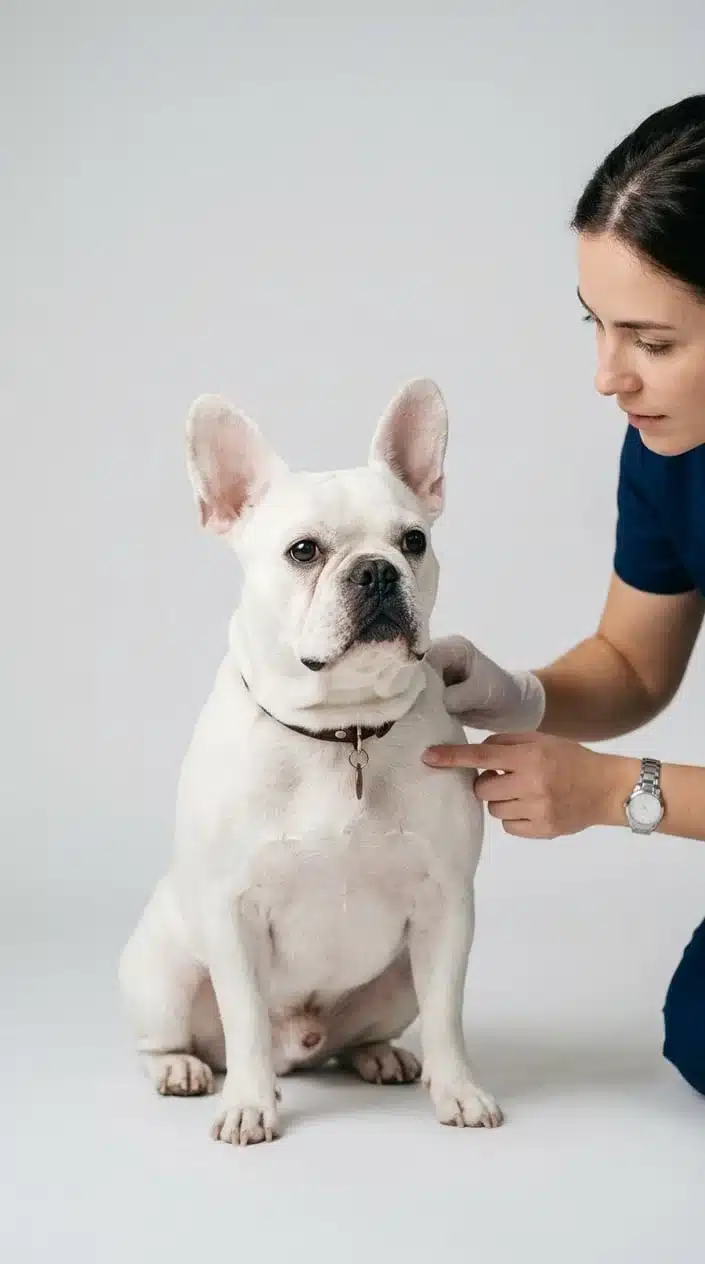
A white French Bulldog may look simple to identify, but a bright-looking coat can have several explanations. A Frenchie described as white may be officially recorded as white, display extensive white spotting, be an extreme pied with almost no visible patches, or actually have a very pale cream or fawn coat.
The difference matters when you are interpreting registration terms, evaluating a puppy, or trying to understand hearing and pigmentation. This guide explains what appearance can tell you, what it cannot confirm, and how white fits into the wider range of French Bulldog colors.
A White French Bulldog is a Frenchie whose visible coat is predominantly white. White is an AKC-accepted color, but a white-looking dog may instead be extensively Piebald, pale Cream, or light Fawn; appearance alone cannot confirm the genetic cause. A white coat also does not prove deafness, so BAER testing is needed to assess each ear.
Key identification and health points:
- White usually appears clear or bright, while Cream has a warmer ivory tone and light Fawn shows pale tan or honey coloring.
- Inspect behind the ears, around the tail, inside folds, and on the underside for small areas of pigmented hair.
- Any colored patches must be evaluated separately because accepted Fawn or Brindle differs from disqualifying pigments and patterns.
- Normal behavior cannot rule out one-sided hearing loss; a BAER test evaluates each ear independently.
What Is a White French Bulldog?

A white French Bulldog is a Frenchie whose visible coat is predominantly white. Some dogs show a clear, bright white coat with no obvious colored areas, while others have tiny fawn or brindle markings hidden near an ear, the tail, a fold, or the underside.
“White” may describe what the dog looks like or how the dog is registered. It does not always identify the exact genetic route that produced the appearance.
Four different ideas are often mixed together:
Get Weekly Dog Care Tips Free
Join 10,000+ dog owners. Vet-approved advice every week
🔒 No spam. Unsubscribe anytime.
- Visible description: The color you can see in ordinary conditions.
- Pattern: The distribution of white and pigmented coat across the body.
- Genotype: The inherited variants affecting color and pattern.
- Registration terminology: The color and markings recorded for the dog.
A photograph can help with visual classification, but it cannot reveal every carried color or pattern.
White is included among the accepted colors in the current AKC French Bulldog standard. The acceptance of a white coat does not make every pigment or pattern combined with white acceptable.
Are White French Bulldogs AKC Recognized?

Yes. The AKC French Bulldog breed standard accepts white, cream, and shades of fawn, including permitted combinations of those colors.
Accepted patterns and markings include brindle, piebald, black masks, black shadings, white markings, and ticking, although ticking is acceptable but not desired.
The color inside any visible patches still matters. For example, a white coat with accepted fawn or brindle patches is different from a white coat combined with a disqualifying pigment or merle pattern.
The standard disqualifies solid black without a trace of brindle, mouse or liver color, black and tan, black and white, white with black, blue, and merle. A dark patch should therefore be inspected closely before it is casually labeled black.
How to Identify a White French Bulldog

Begin with indirect natural daylight. Indoor bulbs can add yellow warmth, while bright sunlight and phone-camera exposure can erase the faint ivory or tan tones that distinguish cream and light fawn from white.
| What you observe | Possible classification | What to check next |
|---|---|---|
| Bright white coat with no obvious patches | White or an extreme-white expression | Inspect hidden areas and review pedigree or testing |
| Warm, evenly colored ivory coat | Cream | Compare in natural light and examine pigment |
| White coat with defined fawn or brindle areas | Pied | Identify the pigment in every patch |
| Pale tan or honey warmth | Light fawn | Compare the ears, back, and roots of the coat |
| Small colored flecks in white hair | Ticking | Confirm that pigment is in the hair, not only the skin |
| Irregular mottling within colored areas | Possible merle | Do not rely on a seller label; seek reliable evaluation |
A Ten-Step Identification Process
- View the dog in indirect natural daylight.
- Decide whether the coat appears bright white, warm ivory, or pale tan.
- Inspect the whole body for small colored patches.
- Check around the ears, tail base, folds, belly, and underside.
- Examine every dark patch for fawn hairs or brindle striping.
- Separate pigment in the hair from spots visible only in the skin.
- Check the nose, lips, eye rims, and paw pads for pigmentation.
- Look for irregular mottling that may indicate merle.
- Compare clear, unedited puppy and current photographs.
- Review registration, pedigree, and reliable laboratory results when precise classification matters.
This process gives you a stronger visual description, but it cannot promise a definitive genotype from appearance alone.
White vs. Cream French Bulldog

A white Frenchie generally looks clear or bright white. A cream French Bulldog usually has an even ivory, eggshell, or warm off-white cast.
| Feature | White French Bulldog | Cream French Bulldog |
|---|---|---|
| Overall tone | Clear or bright white | Warm ivory or off-white |
| Distribution | May involve extensive white spotting | Usually looks evenly colored |
| Visible patches | May be absent, tiny, or obvious | Distinct colored patches are not typical of a visually solid cream |
| Pigmentation | Evaluate nose and eye rims separately | Standard cream usually retains strong dark pigment |
| Best comparison | Indirect natural daylight | Indirect natural daylight |
| Genetic certainty | Appearance may not explain the cause | Testing can help distinguish similar pale coats |
White shampoo, staining, shadows, filters, and camera exposure can change how either coat appears. Compare the same dog in several unedited photographs rather than judging a single overexposed image.
White vs. Pied and Extreme Pied
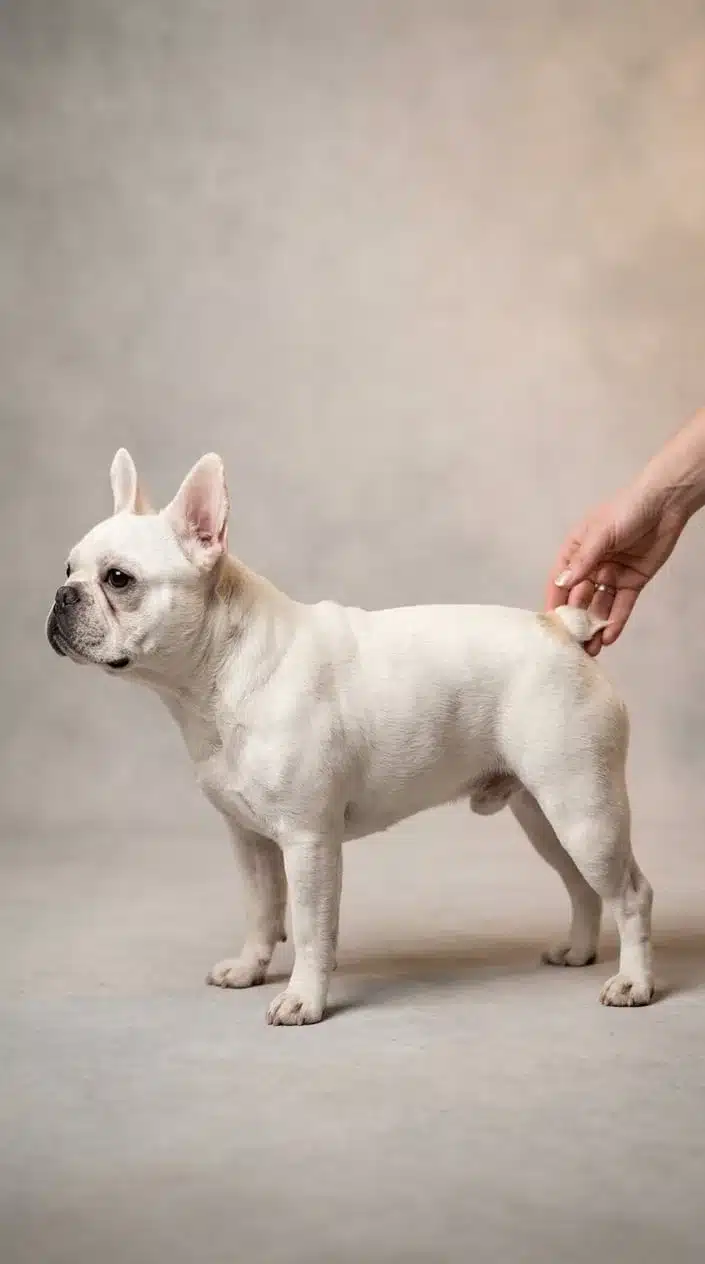
A pied French Bulldog has white spotting with identifiable areas of pigmented hair. In a typical pied dog, the patches may be large and easy to see. In an extreme or minimally marked pied, so little pigmented hair may remain that the dog looks all white.
A tiny patch may sit behind an ear, near the tail, inside a fold, or on the underside. This is why “all white” and “genetically pure white” should not be treated as interchangeable claims.
Some white-looking Frenchies may show extensive white spotting, but appearance alone does not prove the underlying genotype. Use careful inspection and supporting records when the distinction matters.
White vs. Limited White Markings
Not every French Bulldog with white fur should be called a white Frenchie. A fawn dog may have a white chest, and a brindle dog may have white toes or a facial blaze without being predominantly white.
| Appearance | Likely everyday description |
|---|---|
| Mostly fawn with a small white chest | Fawn with white markings |
| Mostly brindle with white toes or blaze | Brindle with white markings |
| Substantial fawn and white areas | Fawn and white or white and fawn, depending on visible distribution |
| Substantial brindle and white areas | Brindle and white or white and brindle |
| Broad white distribution with defined patches | Pied |
| Almost entirely white with little visible color | White or extreme pied requiring closer evaluation |
Registration language, casual visual labels, and genetic test terminology do not always map neatly onto one another.
How to Check Dark Patches: Black or Brindle?
A densely brindle French Bulldog can appear almost black in indoor light or photographs. A white-and-brindle dog may consequently be advertised as “black pied” or “white with black spots.”
Inspect every dark area under indirect sunlight. Look for even a trace of fawn hair or striping, including along the patch edges and in areas behind the ears or near the tail.
Do not classify a dark patch from one filtered photograph. Brindle traces may be subtle, and identifying them can change how the visible combination is described under the breed standard.
Ticking, Skin Pigment, Pied Patches and Merle
Owners often use “spots” for several different features. The location of the pigment—in hair, skin, or a larger coat patch—helps separate them.
| Feature | Basic appearance |
|---|---|
| Ticking | Small pigmented hairs or flecks inside white coat areas |
| Pigmented skin | Dark skin spots visible beneath otherwise white hair |
| Pied patch | A larger, defined area of colored hair |
| Brindle | Dark striping over a fawn background within pigmented hair |
| Merle | Irregular mottling or dilution within pigmented coat areas |
Ticking is acceptable but not desired under the AKC standard. It is not a separate pied color, and it does not automatically disqualify a white or pied Frenchie.
Freckled skin seen through white hair is not automatically coat ticking. Part the hair gently and determine whether the colored flecks are in the hair shafts or only in the skin.
Small spots becoming noticeable as a puppy grows may be ticking or increasingly visible skin pigment. They do not necessarily mean that a major new pied patch has appeared.
White vs. Light Fawn, Merle, Platinum and Albino
White vs. Light Fawn
A very pale fawn French Bulldog retains a tan, biscuit, honey, or warm cast. Look at the ears, back, and roots of the coat in natural light, where subtle fawn pigment is often easiest to detect.
White vs. Merle
Merle produces irregular mottling within pigmented areas. A dog may show both extensive white and merle, but the white areas do not make merle acceptable under the AKC standard.
White vs. Platinum
“Platinum” is commonly used by breeders for a very pale dog that carries other pigments or patterns. It is not a separate accepted color named in the AKC standard. The label should not replace a clear explanation of visible color, pedigree, and test results.
White vs. Albino
A white coat does not automatically mean albinism. Coat color, skin pigment, eye pigment, and the underlying genetic cause must be considered separately.
A normal-looking dark nose or eye rims can provide useful visual information, but owners should not attempt to confirm or exclude albinism through an online checklist. Veterinary and appropriate genetic evaluation are more reliable when albinism is genuinely suspected.
White French Bulldog Genetics in Plain English
White appearance can be influenced by how pigment is produced and how pigmented cells are distributed during development. White spotting in dogs is associated with the S locus and variants near the MITF gene, but expression is not perfectly uniform.
Pied is often described as recessive because a dog can carry a pied-associated variant without displaying a clearly pied coat. Two visually non-pied parents may therefore produce pied puppies if both pass the relevant inherited variant.
That shorthand does not predict exact patch placement. Puppies in the same litter can inherit similar variants yet display different amounts and distributions of white.
The UC Davis Veterinary Genetics Laboratory explains that French Bulldog coat testing can identify several relevant variants. However, no color panel can replace visual evaluation, pedigree context, or breed-relevant health screening.
Genotype means the inherited variants a dog carries. Phenotype means the appearance those variants produce. A white-looking phenotype cannot reveal every hidden color or pattern in the genotype.
A coat-color panel may help explain pigmentation, but it does not assess breathing, spine, heart, joints, eyes, or overall breeding quality.
Do White French Bulldog Markings Change With Age?
Major colored patches generally stay in the same locations, but their proportions may appear different as the puppy’s head and body grow. A small ear patch may look less prominent on an adult than it did in a newborn photograph.
Other visible changes can include:
- Ticking becoming easier to see later.
- Skin pigmentation showing more clearly through the coat.
- Nose and eye-rim pigment developing further.
- Subtle cream or light-fawn warmth becoming more noticeable.
- Brindle traces inside a dark patch becoming easier to detect.
- Tear, saliva, or paw staining changing the apparent coat color.
- Different cameras making white areas look larger or brighter.
Birth photographs cannot guarantee the exact adult appearance. Ask for clear, unedited images taken over time if color identification matters to you.
Eye Color, Pink Noses and Pigmentation
White coat color, blue eyes, and a pink nose should be evaluated as separate features rather than assumed to have one cause.
Young puppies may show lighter-looking eyes or incomplete nose pigment that changes as they mature. Persistent light eyes, a partially pink nose, spotted nose pigment, and reduced eye-rim pigment require individual assessment.
New or progressive pigment loss is different from stable coloring present since puppyhood. Irritation, injury, inflammation, or other conditions can affect pigment, so a veterinarian should examine unexplained changes.
Are White French Bulldogs More Likely to Be Deaf?
Genes associated with white pigmentation and piebald patterns are linked with congenital sensorineural deafness in dogs. This does not mean that every white French Bulldog is deaf or that coat appearance can diagnose hearing.
A dog may have normal hearing in both ears, hearing in only one ear, or hearing loss in both ears. Unilateral deafness can be difficult to recognize at home because the dog may respond normally using the hearing ear.
A BAER test—brainstem auditory evoked response—records the electrical response to sound and evaluates each ear separately. The Orthopedic Foundation for Animals states that BAER testing may be performed from at least 35 days of age.
Louisiana State University’s veterinary guidance explains the relationship among melanocytes, white pigmentation, and pigment-associated congenital deafness. Reliable French Bulldog-specific prevalence figures are limited, so broad percentages from other breeds should not be presented as Frenchie facts.
A white coat cannot confirm normal or impaired hearing. Ask for documented BAER results for each ear when evaluating a white or near-white puppy.
Do White French Bulldogs Have More Health Problems?
White is a coat description, not a disease. It does not automatically shorten lifespan, determine personality, or predict affection, stubbornness, or intelligence.
Pigmentation-associated hearing deserves specific attention, but BAER testing covers hearing only. It does not evaluate the other important French Bulldog concerns involving breathing, spine, joints, heart, eyes, skin, or heat tolerance.
A standard color also does not guarantee responsible breeding. Health decisions should be based on documented screening, sound structure, temperament, pedigree transparency, and veterinary care—not color alone.
Are White French Bulldogs Rare or More Expensive?
White is an established color in the breed standard, so the word “white” alone does not establish rarity. A unique patch location also does not prove that a dog has a rare or more valuable genotype.
Sales terms such as “snow white,” “pure white,” “exotic white,” “platinum white,” or “one of a kind” may describe appearance or create urgency. Ask the seller to explain what the dog is registered as, what pigment is visible, what testing supports the description, and why the price differs.
A higher price does not demonstrate better hearing, breathing, structure, or long-term health.
Responsible Breeder Checklist for a White Puppy
Before choosing a white French Bulldog puppy, request evidence rather than relying on a color label.
- Documented BAER results showing the outcome for each ear.
- Breed-relevant health screening records for both parents.
- Transparent registered colors and pedigrees for the parents.
- Clear, unedited puppy photographs in natural light.
- An honest explanation of any patches, ticking, or reduced pigment.
- No claim that a coat-color DNA panel equals health testing.
- No personality guarantees based on white coloring.
- No pressure based on “rare color” pricing or artificial urgency.
- Written veterinary, vaccination, and health documentation.
- A contract and a willingness to remain available after placement.
Be cautious when a seller uses “rare white” to justify a premium but will not provide BAER results or breed-relevant health records. Marketing language is not evidence of responsible breeding.
Frequently Asked Questions
Is an all-white Frenchie actually pied?
It may be, particularly when extensive white spotting leaves only a tiny visible patch. However, appearance alone cannot prove the underlying genotype, so records and appropriate testing may be necessary.
Is my French Bulldog white or cream?
White generally looks clear and bright, while cream has an even warm ivory cast. Compare the dog in indirect natural light and use several unedited photographs rather than one overexposed image.
Why is my white French Bulldog getting spots?
Ticking may become more visible as a puppy matures, and pigmented skin can show through white hair. New skin lesions, irritation, or progressive pigment loss should be examined by a veterinarian.
Can white French Bulldogs have blue eyes?
Some puppies have lighter-looking eyes, and persistent blue or light eyes can occur with different pigmentation patterns. Eye color alone does not prove albinism or a particular coat genotype.
Is ticking allowed on a white French Bulldog?
Yes. The AKC standard describes ticking as acceptable but not desired. Ticking means small pigmented hairs or flecks in white coat areas, not large pied patches or spots visible only in the skin.
Can two non-pied Frenchies produce a pied puppy?
Yes, if both parents carry and pass relevant pied-associated variants. Carriers may not look pied, and the amount or placement of white cannot be predicted precisely from a simple visual formula.
Does a pink nose mean a white Frenchie is albino?
No. Partial or reduced nose pigment does not by itself confirm albinism. Coat, skin, eyes, developmental history, and appropriate veterinary or genetic evaluation must be considered together.
Do white French Bulldogs need BAER testing?
BAER testing is the objective way to document hearing in each ear and is especially valuable for white or near-white puppies. Normal behavior at home cannot reliably exclude one-sided hearing loss.
Final Takeaway
A white French Bulldog may be visually white, extensively pied, pale cream, or light fawn, and those possibilities cannot always be separated from a photograph. Natural-light inspection, accurate records, pedigree context, and appropriate testing provide a more reliable answer.
White is recognized under the AKC breed standard, but the pigment and pattern combined with it still matter. If you are considering a puppy, prioritize documented BAER results and complete breed-relevant health screening over claims about rarity, purity, or price.