Pied vs. Cream French Bulldog: Color, Pattern and Genetics Difference

Pied and Cream are often listed beside each other on French Bulldog color charts, which makes them sound like competing coat colors. They are not. Cream describes the pigment you see in the hair, while Pied describes how white spotting breaks up that pigment across the body.
That distinction explains why some Frenchies are easy to label and others are not. A dog can be Cream, Pied, or both Cream and Pied. Pale Cream patches can also blend into white areas so closely that ordinary photos hide the pattern.
This guide compares the visible coat, genetics, registration language, and breed-standard terms so you can identify the difference without relying on a breeder label alone.
Pied vs. Cream French Bulldog is a pattern-versus-color comparison: Pied is white spotting that leaves one or more areas of pigmented hair, while Cream is a generally uniform pale ivory or warm off-white coat color. A French Bulldog can express both traits as Cream Pied, so Pied and Cream are not mutually exclusive.
The key differences are:
- Pied describes where white spotting appears; the remaining patches can be Cream, Fawn, Brindle, or another color or pattern.
- Cream describes the color of the pigmented hair, not the placement of white areas.
- Cream Pied can be difficult to identify because pale Cream patches may blend visually with white hair.
- Coat appearance in neutral daylight, supported by correctly interpreted E-locus and S-locus results, is more reliable than a breeder label or photograph alone.
Pied vs. Cream French Bulldog at a Glance
The quickest way to understand this comparison is to ask what each word describes. “Cream” answers what color is the pigmented hair? “Pied” answers where has white spotting removed visible coat pigment?
| Feature | Pied French Bulldog | Cream French Bulldog |
|---|---|---|
| What the term describes | A white-spotting pattern | A pigment color |
| Typical appearance | Broad white areas with defined colored patches | Generally uniform ivory or warm Cream |
| Main genetic association | S locus and MITF | E locus and MC1R |
| Can another trait be present? | Yes; the patches still have a color or pattern | Yes; Cream can occur with white markings or Pied patterning |
| Common identification problem | Extreme Pied may look almost White | Pale Cream may look White or light Fawn |
| Can a dog be both? | Yes. Cream Pied combines Cream pigment with Pied white spotting. | |
For the larger framework behind these labels, see our French Bulldog Colors guide. It separates colors, patterns, markings, and pigment modifiers instead of treating every coat term as the same type of trait.
Get Weekly Dog Care Tips Free
Join 10,000+ dog owners. Vet-approved advice every week
🔒 No spam. Unsubscribe anytime.
The Most Important Difference: Pied Is a Pattern
Pied does not tell you the color inside a French Bulldog’s pigmented patches. It describes a distribution of white and colored coat areas. The remaining patches may be Brindle, Fawn, Cream, or another genetically possible color.
This is why “Pied versus Cream” is not a perfectly equal comparison. One term describes a pattern and the other describes pigment. Our complete Pied French Bulldog guide explains how patch size, placement, and color can vary.
Cream and Pied are not mutually exclusive. A French Bulldog can inherit Cream pigment and Pied white spotting, producing a low-contrast Cream Pied coat.
What Is a Pied French Bulldog?
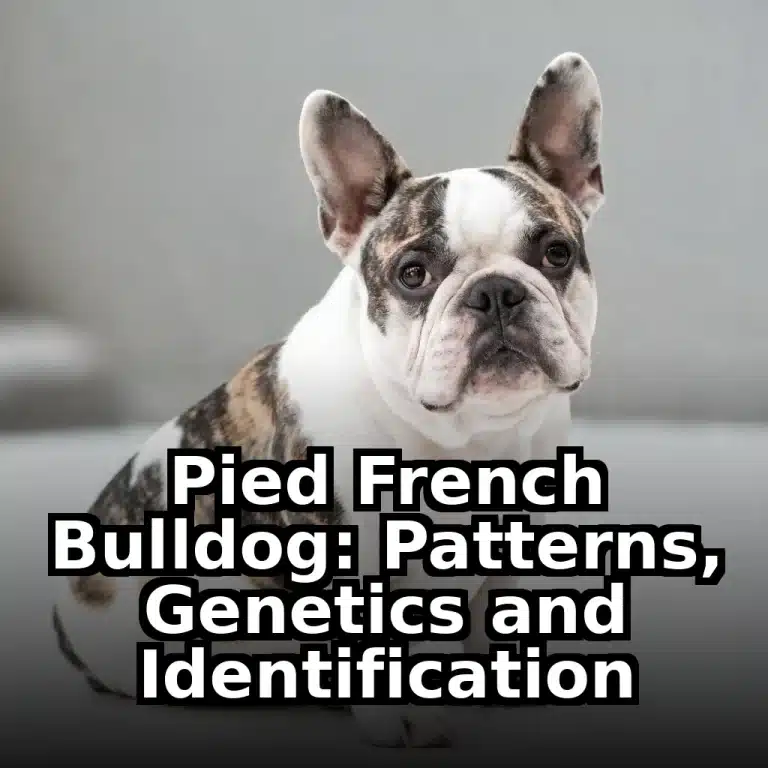
A Pied French Bulldog has extensive white spotting with one or more areas of pigmented hair. The head, ears, shoulders, back, sides, and tail base are common locations for visible patches, but there is no required symmetrical layout.
The contrast depends on the color within those patches. Brindle or dark Fawn patches are usually obvious against white. Pale Cream patches can be much harder to see, especially under bright light.
An extreme Pied may have only a small patch on an ear, around an eye, or near the tail. From the wrong angle, the dog may appear completely White. Our Pied vs. White French Bulldog comparison covers that specific identification problem.
What Is a Cream French Bulldog?
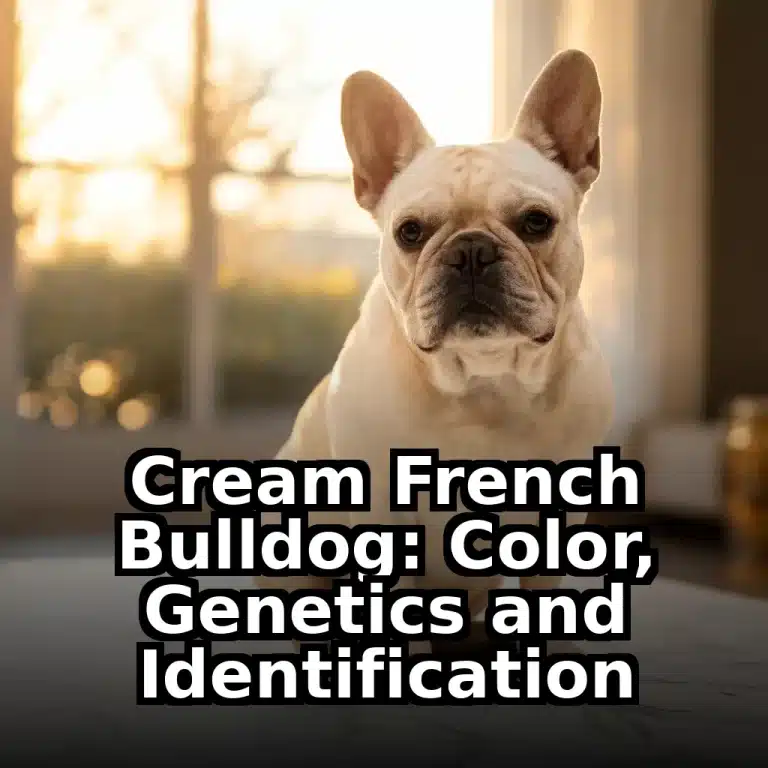
A Cream French Bulldog usually has an even pale ivory, eggshell, or warm off-white coat. The color should not look like bright unpigmented white when viewed beside a truly white object in neutral daylight.
A standard Cream Frenchie normally retains dark pigment on the nose, lips, eye rims, and paw pads. Coat color and skin pigment are related through several genetic pathways, but they are not the same feature.
Cream is also commonly confused with very light Fawn. Cream tends to look more uniform, while light Fawn may retain warmer shading or deeper color around the ears, back, or head. See our Cream French Bulldog guide for a closer comparison of Cream, White, and pale Fawn.
Can a French Bulldog Be Both Cream and Pied?
Yes. A Cream Pied French Bulldog expresses pale Cream pigment together with Pied white spotting. The white areas contain unpigmented hair, while the patches contain Cream hair.
The combination can be surprisingly subtle because bright white and pale Cream may have very little contrast. On some dogs, the Cream areas are easiest to see around the ears, crown, shoulders, back, or base of the tail.
Breeders may use the informal term “Honey Pied” for a warm Cream Pied or very pale Fawn Pied. That phrase is not a universal genetic or kennel-club classification. Ask what the label means, what is visible on the dog, and which DNA results support it.
A Cream Pied coat also illustrates why registration labels and DNA genotypes should not be treated as identical. A form may use one practical visual label even when the dog’s full genetic result includes more information.
How to Identify Pied, Cream and Cream Pied
Check Whether the Coat Is Uniform
Begin by looking at the entire dog rather than one bright photograph. A Cream Frenchie usually appears evenly ivory or warm off-white. A Pied dog has separate regions of white hair and pigmented hair, even if the contrast is faint.
Look for Defined Patch Borders
Inspect the coat where one shade changes to another. Pied patches often have a recognizable border, although the edge may be irregular. Normal shadowing tends to change gradually with the direction of the light.
Compare the Coat With a White Object
Place plain white paper or untreated white fabric beside the dog without covering the coat. Cream hair normally keeps an ivory, biscuit, or pale yellow undertone. True white hair should look closer to the comparison object.
Use Neutral Daylight
Check the dog near a window or outdoors in open shade. Avoid direct golden sunlight, blue-tinted indoor bulbs, strong flash, beauty filters, and overexposed photos because each can alter a pale coat.
Inspect the Ears, Head and Tail Base
Low-contrast patches may remain easiest to see on the ears, crown, shoulders, spine, or tail base. Look at every area separately and part the short hair gently when a border seems unclear.
Compare Puppy and Adult Photographs
A puppy’s coat intensity and contrast may become easier or harder to see as the coat matures. Compare unedited images taken in similar light rather than deciding from one newborn photograph.
| Visible Appearance | Most Likely Explanation | Best Clue to Check |
|---|---|---|
| Uniform ivory or warm off-white | Cream | No separate bright-white regions or patch borders |
| Mostly white with obvious colored patches | Pied | Clear transition between white and pigmented hair |
| White with very pale ivory patches | Cream Pied | Subtle patch borders in daylight |
| Nearly all white with tiny pigmented areas | Extreme Pied | Small patch near an ear, eye, or tail base |
| Pale beige with warmer shading | Light Fawn | Deeper tone on ears, head, or back |
| Dark areas visible below white hair | Skin pigmentation | Hair remains white when parted |
Why Cream Pied Can Be Difficult to Recognize
The main problem is low contrast. Dark Brindle or Fawn patches stand out clearly against white, while pale Cream patches may differ by only a small change in warmth or intensity.
Camera processing can erase that difference. Automatic exposure often brightens light coats, white balance can remove warm undertones, and phone filters can smooth the border between Cream and White.
Grooming products, surface staining, wet hair, reflected colors, and dark skin visible beneath white fur can also mislead you. A real Cream patch is made of Cream-colored hair; it is not a shadow or pigment underneath white hair.
If the visible patches are clearly Fawn rather than Cream, compare them with the examples in our Brindle Pied vs. Fawn Pied French Bulldog guide. It explains how to assess the pattern inside each colored patch.
Pied vs. Cream French Bulldog Genetics
Cream and the E Locus
Cream expression is mainly associated with recessive variants at the E locus involving the MC1R gene. When a dog inherits the relevant recessive genotype, dark eumelanin production is restricted in the hair, and the visible coat can range through Cream, yellow, or red tones.
This is more precise than calling Cream a simple “dilution.” The recessive E-locus effect changes which pigment is expressed in the hair, while genes affecting intensity help influence how pale or deep that visible color becomes.
Pied and the S Locus
Pied white spotting is associated with the S locus and variants near the MITF gene. These influence where pigment-producing cells are present during development, creating white areas in the coat.
White distribution is variable. Dogs with similar reported results can show different amounts or placements of white, so a DNA result should be interpreted alongside the actual coat and family information.
What Cream Pied DNA May Show
A Cream Pied dog may have a recessive Cream-associated E-locus result together with Pied-associated S-locus findings. These results answer separate questions and must be read together.
A dog may also carry a Pied-associated variant without displaying a clearly Pied coat. Ask whether the laboratory result predicts visible expression, carrier status, or only the presence of a tested variant.
Review the E locus and S locus as separate results. Then ask the laboratory how those findings fit the dog’s visible coat instead of treating one test line as the complete color diagnosis.
AKC, UK and FCI Classification
Breed organizations do not use Cream and Pied terminology in exactly the same way. That can create confusion when owners compare a US registration, a UK breed description, and an international standard.
| Organization | Cream | Pied | Important Detail |
|---|---|---|---|
| AKC—United States | Accepted color | Accepted pattern | White, Cream, Fawn, and permitted combinations are included in the written standard |
| Royal Kennel Club—UK | Not listed as a separate correct color | Listed as a correct color description | Cream shades of Fawn are described as less desirable |
| FCI—International | Not separately named like the AKC color | Used for Fawn or Brindled coats with white spotting | The standard describes Fawn, Brindled or not, with or without white spotting |
The AKC French Bulldog standard accepts Cream and recognizes Piebald as a pattern. The Royal Kennel Club standard and FCI standard organize the same general coat traits differently.
Registration wording is still not a complete genetic report. A dog’s visual label, registered color, DNA genotype, breeder description, and show eligibility answer different questions.
Does Pied or Cream Affect Health or Temperament?
Pied and Cream do not create separate French Bulldog personalities. Temperament is shaped by genetics beyond coat color, early socialization, training, health, and the dog’s environment.
Neither label replaces breed-wide health screening. Responsible evaluation should still consider breathing function, spine, patellas, eyes, heart, and other French Bulldog concerns.
Extensive lack of pigment can be relevant when congenital deafness is being evaluated in dogs, but a Pied label does not prove that an individual Frenchie is deaf. When hearing is uncertain, a BAER test evaluates each ear objectively.
What to Ask a Breeder or DNA Laboratory
Ask for information that separates the dog’s appearance from marketing language. Useful questions include:
- Is the coat being described from the dog itself or only from parent DNA?
- Where are the visible white areas and Cream patches?
- Were the photographs taken in neutral daylight without filters?
- What does the E-locus result show?
- What does the S-locus or white-spotting result show?
- Does the dog express Pied, or does it only carry a tested variant?
- Is “Honey Pied” being used as an informal label for Cream Pied or pale Fawn Pied?
- Which breed-wide health tests were completed?
- Was BAER testing performed when hearing status was uncertain?
Frequently Asked Questions
Is Pied a French Bulldog color or a pattern?
Pied is best understood as a white-spotting pattern because it describes the distribution of white and pigmented coat areas. The pigmented patches still have their own color or pattern.
Can a Cream French Bulldog also be Pied?
Yes. A Cream Pied French Bulldog combines Cream-colored hair with Pied white spotting. The pale Cream patches may show very little contrast against the white areas.
What Does a Cream Pied French Bulldog Look Like?
It usually has bright white areas and pale ivory or warm Cream patches. Patch borders may be easiest to see on the ears, head, back, shoulders, or tail base in neutral daylight.
Is Honey Pied the Same as Cream Pied?
“Honey Pied” is informal breeder terminology and is not used consistently. It may refer to Cream Pied or a warm, pale Fawn Pied, so ask for a visual explanation and supporting DNA results.
How Can I Tell Cream From White?
Compare the coat with plain white paper or fabric under neutral daylight. Cream generally keeps an ivory, eggshell, or faint yellow undertone, while white hair lacks that warm tint.
Can DNA Confirm a Cream Pied Frenchie?
DNA can provide strong supporting evidence when the relevant E-locus and S-locus results are interpreted together. It should still be compared with the visible coat and the laboratory’s explanation of expression versus carrier status.
Is Cream Accepted by the AKC?
Yes. Cream is an accepted French Bulldog color under the AKC standard, provided the dog does not express a separate disqualifying color or pattern.
Is Pied Accepted by the AKC?
Yes. Piebald is an accepted French Bulldog pattern under the AKC standard. The color inside the pigmented patches still matters when determining whether the overall coat meets the standard.
Can Cream Hide Other Coat Patterns?
Recessive Cream can prevent some dark-haired patterns from being visible in the coat even when related variants are present genetically. A full report may therefore contain information that appearance alone cannot reveal.
Does a Cream Pied Puppy Change Color?
The basic inherited traits do not change, but coat intensity and contrast may become more or less noticeable as the puppy matures. Compare clear photographs over time under similar lighting.
Final Identification Takeaway
The simplest rule is this: Cream tells you the pigment color, while Pied tells you how white spotting is distributed. A French Bulldog can therefore be Cream, Pied, or both Cream and Pied.
Start with the visible coat in neutral daylight, look for real patch borders, and use E-locus and S-locus results to support—not replace—careful identification. If the dog appears almost completely white, review our White French Bulldog guide before settling on a label.