Can a Corneal Ulcer in a French Bulldog Heal Without Surgery?

Your French Bulldog is squinting, pawing at one eye, and you can see something cloudy on the surface of the cornea. It is alarming — and the question racing through your mind is whether this needs an operating room or whether it can heal on its own.
Can a corneal ulcer in a French bulldog heal without surgery? For many owners, the answer is more hopeful than expected — but it depends heavily on the ulcer’s depth, cause, and how fast you act.
French Bulldogs are especially vulnerable to eye problems because of their flat faces and prominent eyes. Understanding what drives that risk, and what treatment really looks like, can save your dog’s vision.
Can a Corneal Ulcer in a French Bulldog Heal Without Surgery?
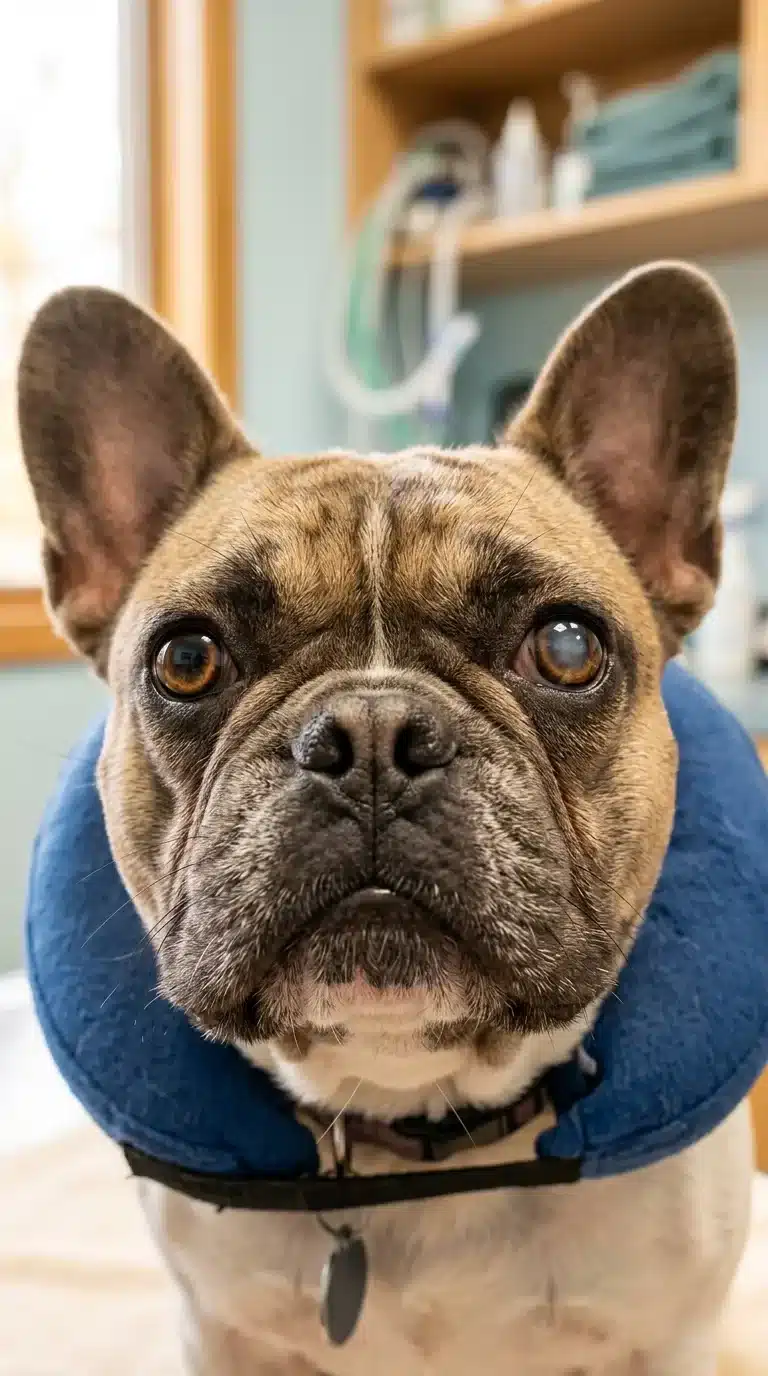
Yes, many corneal ulcers in French Bulldogs heal without surgery — but only superficial ulcers caught and treated early with prescription medications. Deep, infected, or non-healing ulcers almost always require surgical intervention to prevent permanent damage or eye loss.
- Superficial ulcers often heal within 5–7 days with antibiotic eye drops.
- Deep stromal or descemetocele ulcers carry a high risk of eye rupture and need surgery.
- French Bulldogs have shallow eye sockets, making ulcer risk and severity higher than in other breeds.
- A vet diagnosis within 24–48 hours of symptoms dramatically improves outcomes.
- Indolent ulcers — a common non-healing type — may need a minor in-clinic procedure, not full surgery.
- Pain management with atropine or topical NSAIDs is often part of non-surgical treatment.
Why French Bulldogs Are So Prone to Corneal Ulcers
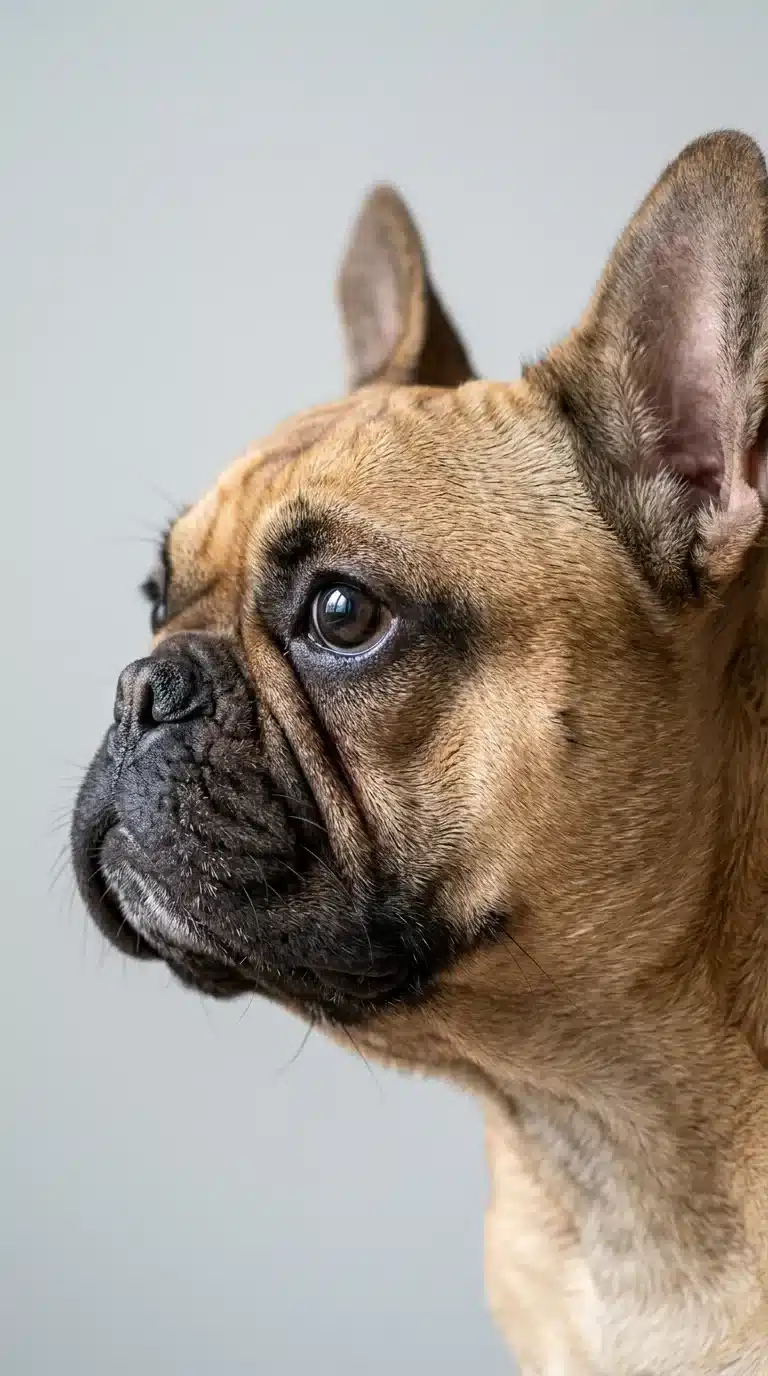
French Bulldogs belong to a group called brachycephalic breeds — dogs with compressed skull structures and flattened muzzles. Their eyes protrude significantly compared to longer-nosed breeds, leaving the cornea exposed and vulnerable.
Get Weekly Dog Care Tips Free
Join 10,000+ dog owners. Vet-approved advice every week
🔒 No spam. Unsubscribe anytime.
The American College of Veterinary Ophthalmologists notes that brachycephalic breeds have reduced blink reflexes and incomplete eyelid closure during sleep, a condition called lagophthalmos. This means the cornea dries out repeatedly, weakening its surface layer over time.
Entropion — where the eyelid rolls inward and lashes scrape the eye — is also common in Frenchies. Combined with their active, curious nature, even a small scratch from a blade of grass or a cat’s claw can break down the corneal epithelium quickly.
BEFORE YOU SCROLL PAST
Readers Also Loved:
👉 How To Spot Early Signs Of Canine Dementia In Senior Dogs
The anatomy of a French Bulldog’s face is the single biggest factor behind their corneal ulcer risk.
If you are researching how big a French Bulldog gets, it is worth knowing that their compact build includes those prominent eyes — a defining trait that comes with real health trade-offs.
Types of Corneal Ulcers: Which Ones Can Heal Without Surgery?

Not all corneal ulcers are equal. The depth of the ulcer into the corneal layers is the single most important factor in deciding whether surgery is needed.
| Ulcer Type | Depth | Surgery Needed? | Typical Healing Time |
|---|---|---|---|
| Superficial epithelial | Surface layer only | Rarely | 5–10 days |
| Indolent (non-healing) | Surface, but won’t close | Minor procedure only | 2–6 weeks |
| Stromal | Middle corneal layers | Often yes | Weeks to months |
| Descemetocele | Near corneal perforation | Yes — urgent | Surgical repair required |
Superficial ulcers respond well to antibiotic drops such as triple antibiotic ophthalmic solution or tobramycin, combined with an Elizabethan collar to stop pawing. An adjustable soft E-collar is one of the most important tools during recovery — your dog rubbing the eye even once can set healing back by days.
Indolent ulcers are a special case. They are superficial but the epithelium refuses to adhere properly to the layer beneath. Vets treat these with a procedure called a grid keratotomy or superficial keratectomy — done under topical anesthesia in clinic, not a full surgical suite.
What Non-Surgical Treatment Actually Looks Like
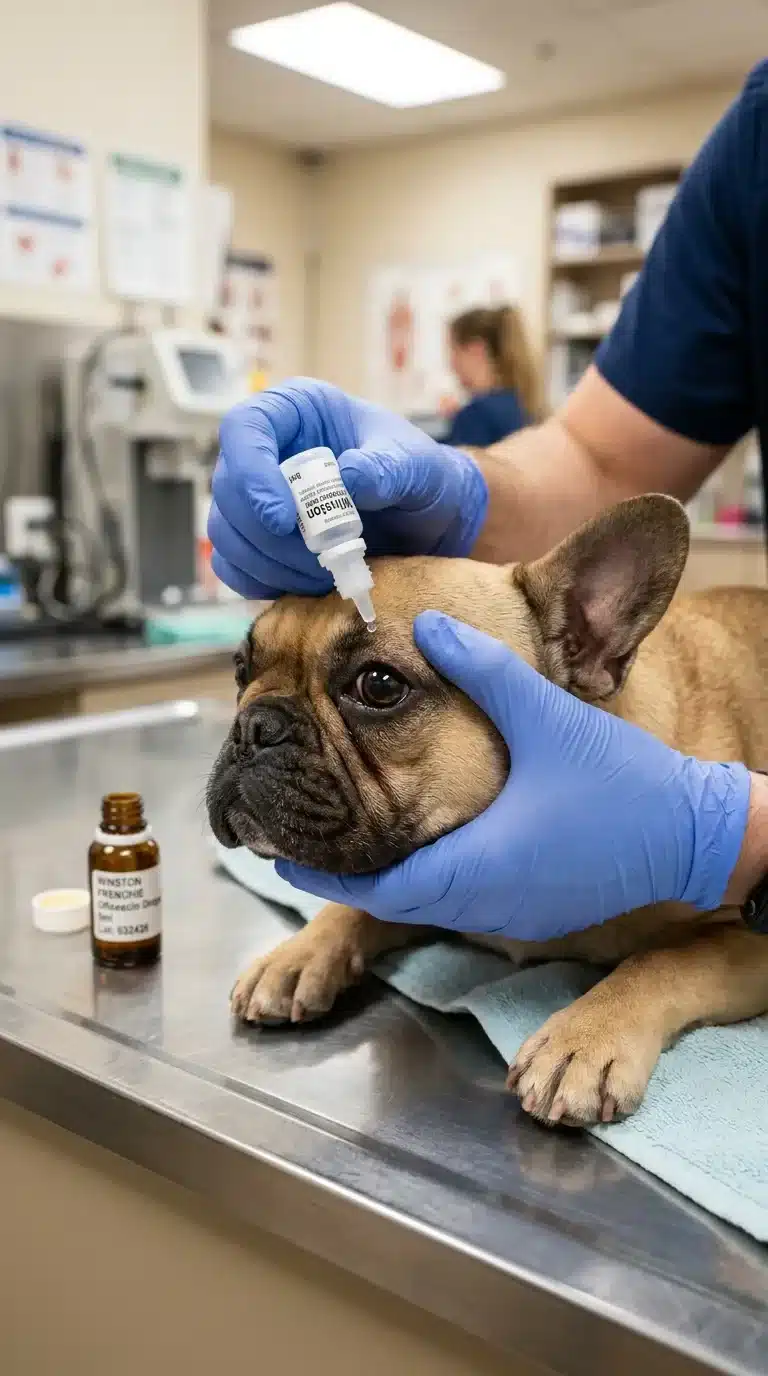
If your vet confirms a superficial ulcer, expect a treatment plan built around three goals: eliminating infection, relieving pain, and protecting the eye from further trauma.
Medications Your Vet Will Likely Prescribe
- Antibiotic eye drops — tobramycin, ofloxacin, or triple antibiotic, applied 3–4 times daily
- Atropine drops — reduces painful ciliary spasm inside the eye
- Serum eye drops — autologous serum (made from your dog’s own blood) promotes healing in stubborn cases
- Oral pain relief — your vet may add a short NSAID course for comfort
Follow-up staining checks with fluorescein dye — usually at day 5–7 — confirm whether the ulcer is closing. If it is not smaller at recheck, the classification changes and so does the plan.
Home Care During Recovery
Keep the E-collar on at all times, including during sleep. Even a brief removal for eating can lead to self-trauma that deepens the ulcer significantly.
BEFORE YOU SCROLL PAST
Readers Also Loved:
👉 How To Care For Your Female Frenchie During Her First Heat
Apply drops exactly on schedule. Missing doses allows bacteria to re-establish or slows the epithelial migration needed for closure. A sterile saline eye wash can keep discharge cleared around the eye between medication times — ask your vet whether this is appropriate for your dog’s specific case.
Never apply any eye drop labeled “for humans only” or containing steroids unless your vet prescribes it — steroids on an active ulcer can cause rapid, catastrophic deepening.
Warning Signs That Surgery Cannot Be Avoided
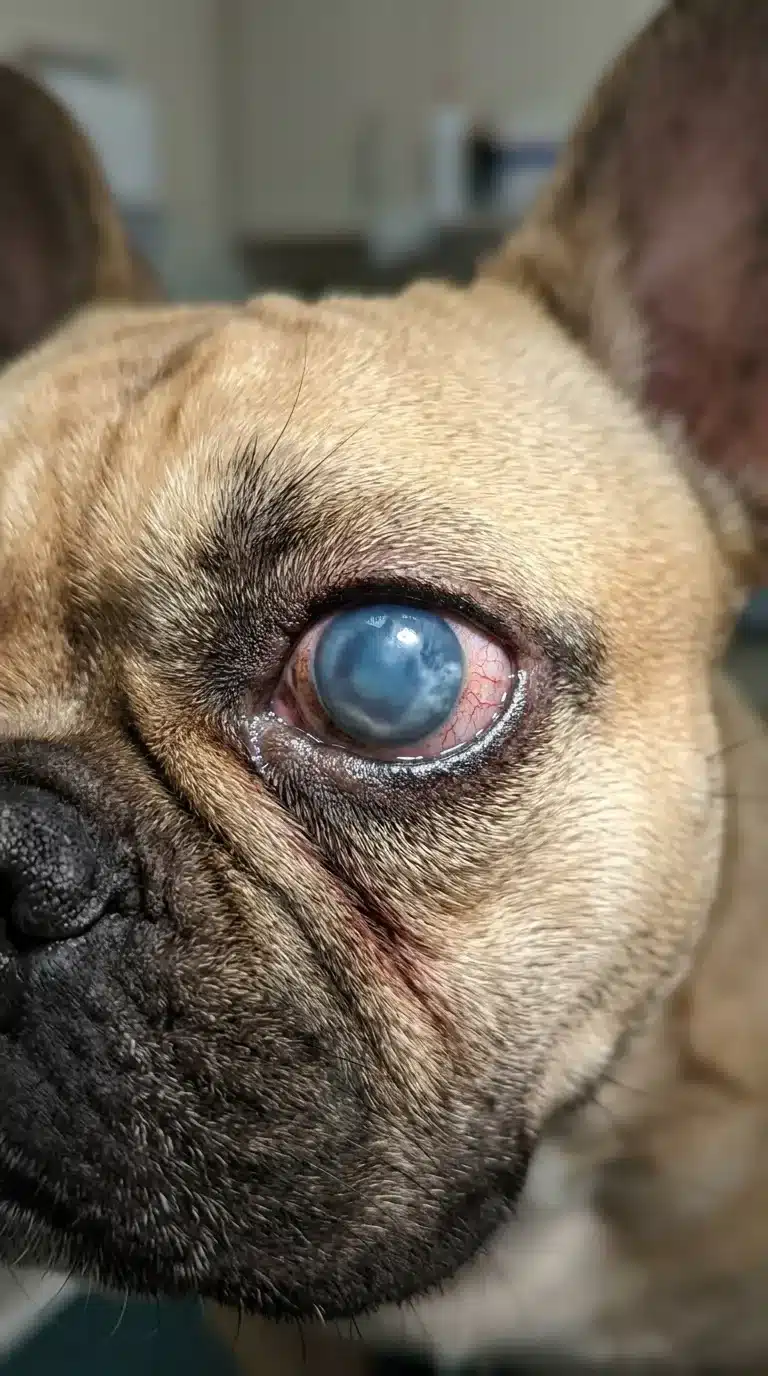
Some ulcers cross a threshold where medical management is no longer safe. Recognizing these signs early gives surgeons the best chance of saving the eye.
- Visible blue or white haze deepening rapidly — suggests stromal involvement or infection spreading
- A dark spot at the ulcer center — may indicate iris tissue visible through a perforation
- No improvement after 7 days of treatment — requires reclassification and likely surgical consult
- Melting appearance — a liquefying cornea caused by bacterial collagenases; this is an emergency
- Hypopyon — white or yellow material settling at the bottom of the eye’s anterior chamber
“Corneal melting ulcers in brachycephalic dogs can progress from treatable to perforation within 24 to 48 hours. These cases require same-day surgical evaluation.” — American College of Veterinary Ophthalmologists guidance on corneal emergencies
Surgical options include a conjunctival graft, where blood-vessel-rich tissue is sutured over the ulcer to deliver nutrients and support healing. In severe cases, a corneoconjunctival transposition or even enucleation (eye removal) may be necessary to eliminate pain and prevent systemic infection.
MOST POPULAR THIS WEEK
Readers Also Loved: 👇
👉 How To Stop Dogs From Scratching Ears Raw
How to Monitor Recovery at Home
Tracking your dog’s progress between vet visits helps you catch deterioration before it becomes a crisis. French Bulldogs cannot tell you when something feels worse — their behavior does.
Daily Signs of Healing
- Reduced squinting and blinking frequency
- Less pawing or rubbing at the face
- Decreased cloudiness or haze over the cornea
- Eye opening more fully and comfortably
Daily Signs of Worsening
- Increased discharge — especially yellow or green mucus
- Visible bulging or change in eye shape
- Sudden increase in pain signals: whimpering, face hiding, appetite loss
- Cloudiness spreading or darkening
Photograph the eye daily in consistent lighting. Side-by-side comparison across three or four days gives your vet valuable information at recheck that verbal descriptions cannot provide.
Given that French Bulldogs already face a range of health considerations — from respiratory challenges to eye issues — being proactive about monitoring matters. You can read more about another common Frenchie health concern in our guide on whether a French Bulldog can get bloat.
Common Mistakes That Delay Healing
- Removing the E-collar “just for a few minutes.” Even brief access lets dogs paw or rub the eye. One scratch can deepen a healing ulcer overnight. Keep it on 24/7 until your vet clears removal.
- Skipping or spacing out eye drop doses. Antibiotic coverage needs consistent blood levels in ocular tissues. Missing doses creates windows for bacterial growth. Use a phone alarm for every scheduled application.
- Using leftover human eye drops or old pet prescriptions. Expired medications lose potency. Human drops may contain preservatives toxic to dogs. Always use the current prescription your vet provides.
- Waiting more than 48 hours before seeing a vet. Owners sometimes hope symptoms will resolve. Corneal ulcers in Frenchies can progress from superficial to deep in under two days. Same-day or next-day vet contact is the right call.
- Stopping treatment when the eye looks better. Eyes can appear improved while the epithelium is still fragile. Completing the full course your vet prescribes prevents relapse and antibiotic resistance.
A veterinary ophthalmic antibiotic is only effective when used exactly as directed — the bottle will not do the work sitting on a shelf.
For more on how your Frenchie’s unique anatomy shapes their health, see our overview of what French Bulldogs are physically capable of as a breed. Understanding their build helps set realistic expectations for recovery and long-term care.
Frequently Asked Questions About Can a Corneal Ulcer in a French Bulldog Heal Without Surgery?
How long does it take for a corneal ulcer to heal in a French Bulldog?
A superficial corneal ulcer in a French Bulldog typically heals within 5–10 days with appropriate antibiotic treatment and an E-collar in place. Deeper or indolent ulcers can take several weeks and may require additional procedures.
What happens if a corneal ulcer goes untreated in a French Bulldog?
An untreated corneal ulcer can progress to a deep stromal ulcer or corneal perforation within days, risking permanent vision loss or requiring eye removal. Prompt veterinary treatment within 24–48 hours is essential to preserve the eye.
Can I treat my French Bulldog’s eye ulcer at home without a vet?
Home treatment alone is not safe for a confirmed or suspected corneal ulcer — prescription antibiotic eye drops require a vet diagnosis. Over-the-counter drops will not eliminate bacterial infection and may delay critical care.
Is corneal ulcer surgery in French Bulldogs expensive?
Surgical repair of a corneal ulcer, such as a conjunctival graft, can cost between $1,000 and $3,500 depending on the procedure complexity and location. Early non-surgical treatment is significantly less expensive when the ulcer is caught at a superficial stage.
Will my French Bulldog’s vision return to normal after a corneal ulcer?
Vision outcomes depend on ulcer depth and how quickly treatment begins. Superficial ulcers usually heal with minimal scarring. Deep ulcers can leave a permanent corneal scar that partially obstructs vision, though dogs adapt well to reduced vision in one eye.
Are French Bulldogs more likely to get repeat corneal ulcers?
Yes — because the anatomical risk factors do not change, French Bulldogs who have had one ulcer are at elevated risk for recurrence. Regular eye cleaning, tear production monitoring, and annual vet eye checks help reduce that risk significantly.
The Bottom Line on Corneal Ulcers and Your Frenchie
The most important thing to take away: a superficial corneal ulcer in a French Bulldog absolutely can heal without surgery — but only with fast veterinary diagnosis, consistent medication, and strict use of an E-collar.
The window between a treatable ulcer and a surgical emergency is narrow, sometimes less than 48 hours. If you notice squinting, cloudiness, or eye discharge today, contact your vet today — not tomorrow.
If you are still building your knowledge about French Bulldog health and care, our article on how many litters a French Bulldog can safely have covers another important aspect of this breed’s unique health profile. Learn more about where to find a reputable French Bulldog breeder who screens for eye and other structural health issues — it is the best first step toward a healthier dog. For those managing an eye-healthy recovery long term, a quality veterinary lubricating eye drop can support corneal moisture between prescribed treatments, with your vet’s approval.