Do I Really Need to Brush My F1 Medium Goldendoodle Every Day?

Your F1 Medium Goldendoodle has that irresistible wavy coat — and it mats faster than almost any other dog breed. If you’ve been asking yourself, do I really need to brush my F1 Medium Goldendoodle every day? the honest answer depends on your dog’s specific coat type, age, and lifestyle. Getting this wrong is expensive: a full dematting groom can cost $75–$150 or more at a professional salon.
F1 Goldendoodles are 50% Golden Retriever and 50% Poodle, which creates a mixed-generation coat that can vary from wavy to loosely curly. That genetic combination also means coat behavior can be unpredictable, even within the same litter.
If you’re also curious about size differences across generations, the Toy Goldendoodle guide covering price, size, and lifespan offers useful context on how coat care needs shift with dog size.
Do I Really Need to Brush My F1 Medium Goldendoodle Every Day?

Most F1 Medium Goldendoodles need brushing at least 3–4 times per week, and daily brushing is strongly recommended during coat transition (between 6 and 14 months of age). The American Kennel Club notes that mixed-breed dogs with Poodle lineage often develop dense, tangle-prone coats that require more frequent maintenance than single-breed dogs with straighter fur.
- F1 Goldendoodles have a wavy or loosely curly coat that mats in high-friction zones within 24–48 hours.
- Puppies undergo a coat transition between 6–14 months that increases matting risk significantly.
- Daily brushing sessions of 10–15 minutes prevent mats better than longer, less frequent sessions.
- Medium-sized Goldendoodles (30–45 lbs) have more coat surface area than Toy sizes, raising the time commitment.
- Post-swim and post-rain brushing is non-negotiable — wet fur mats as it dries.
- Skipping brushing for 3+ days during coat transition can result in full-body matting that requires a shave-down.
Understanding the F1 Goldendoodle Coat: Why It Mats So Easily
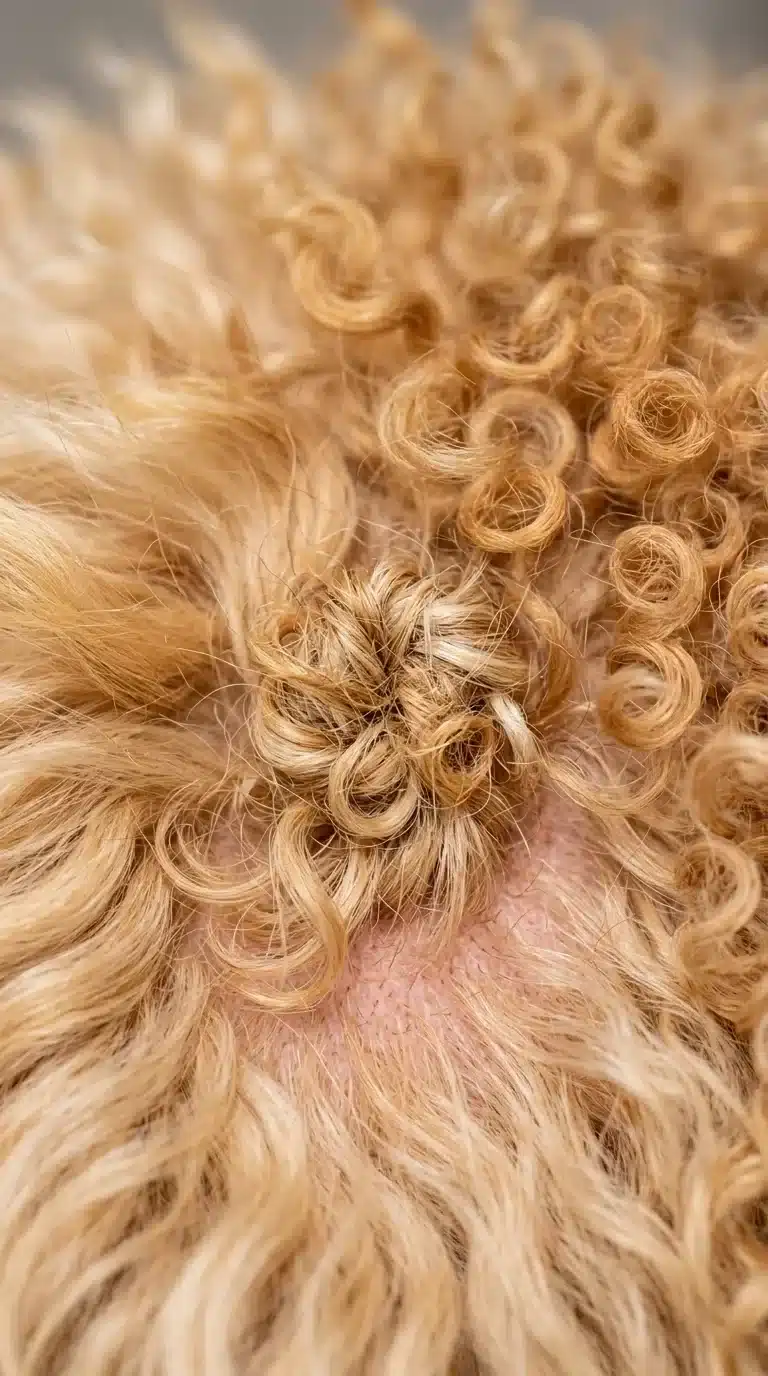
The F1 Goldendoodle coat is a first-generation cross, meaning each dog inherits a unique blend of the Golden Retriever’s double coat and the Poodle’s dense, curly fur. According to the American Animal Hospital Association (AAHA), mixed-breed dogs with Poodle genetics often have coats that trap shed fur rather than releasing it, which is the root cause of matting.
Get Weekly Dog Care Tips Free
Join 10,000+ dog owners. Vet-approved advice every week
🔒 No spam. Unsubscribe anytime.
Unlike a purebred Golden Retriever, shed hair in a Goldendoodle doesn’t fall to the floor. It gets caught in the surrounding curls and twists into knots.
High-friction zones — armpits, collar area, behind the ears, and groin — mat fastest and need daily attention even when the rest of the coat only needs 3–4x per week.
BEFORE YOU SCROLL PAST
Readers Also Loved:
👉 How To Spot Early Signs Of Canine Dementia In Senior Dogs
Wavy vs. Loosely Curly F1 Coats
Not every F1 looks the same. A wavier coat is slightly more forgiving and may need brushing every other day. A tighter curl pattern demands daily work.
| Coat Type | Brushing Frequency | Mat Risk | Grooming Cost |
|---|---|---|---|
| Wavy (flatter waves) | 3–4x per week | Moderate | Lower |
| Loosely curly | 5–7x per week | High | Higher |
| Coat transition phase | Daily | Very high | Highest if neglected |
The Coat Transition Phase: The Highest-Risk Window
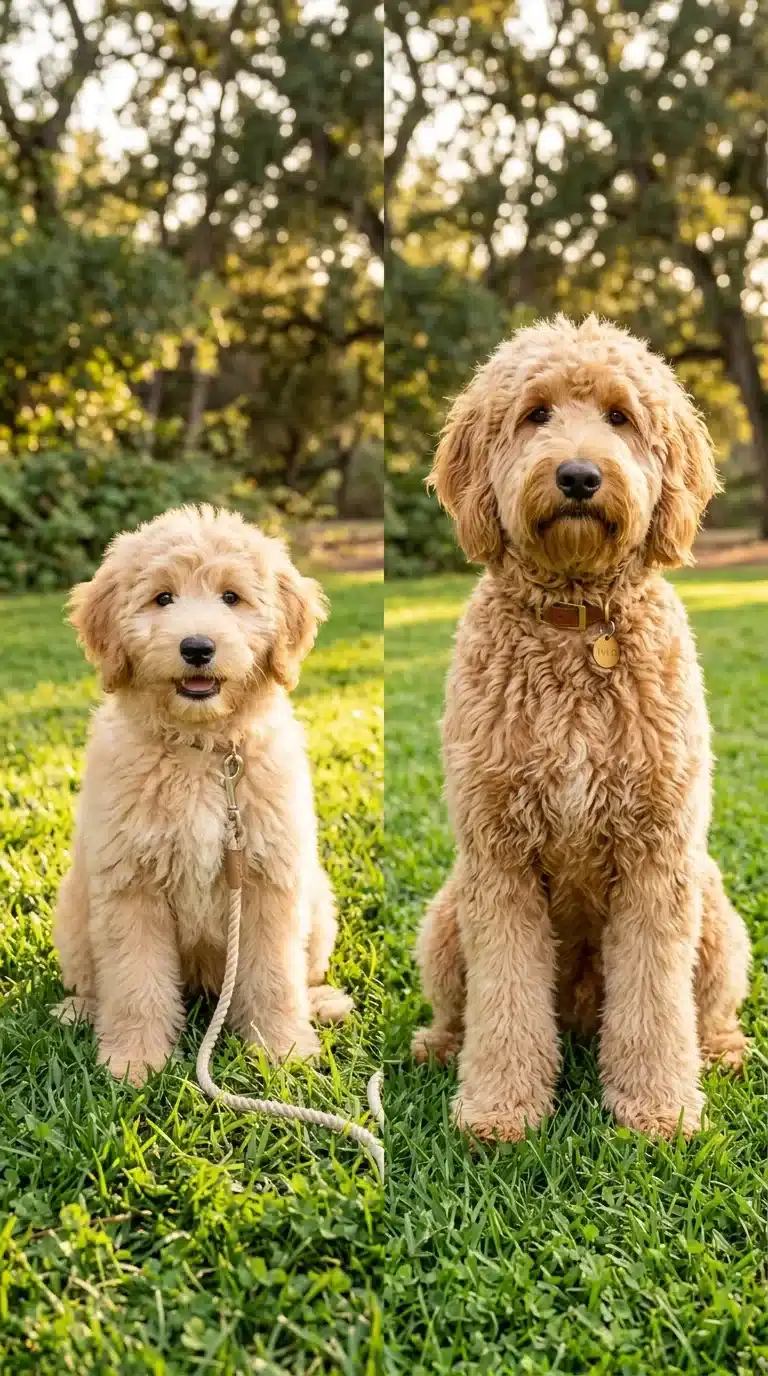
Between 6 and 14 months of age, F1 Goldendoodles shed their softer puppy coat and grow in their adult fur. This period is the single most common cause of severe matting in Goldendoodles, and daily brushing during these months is not optional.
During transition, old puppy coat and new adult coat coexist in the same follicles. The two textures interlock and create knots in under 48 hours, especially after swimming or rough play.
- Brush the entire coat once per day — not just visible tangles.
- Use a dematting comb for early-stage knots before they tighten.
- Schedule a professional groom every 6–8 weeks during this phase to keep length manageable.
- Ask your groomer to do a “puppy cut” or shorter trim to reduce daily brushing burden.
Once adult coat is fully established — typically by 14–18 months — some dogs can drop back to 3–4x per week. Others, particularly those with tighter curls, stay on a daily schedule permanently.
How to Brush an F1 Medium Goldendoodle Correctly
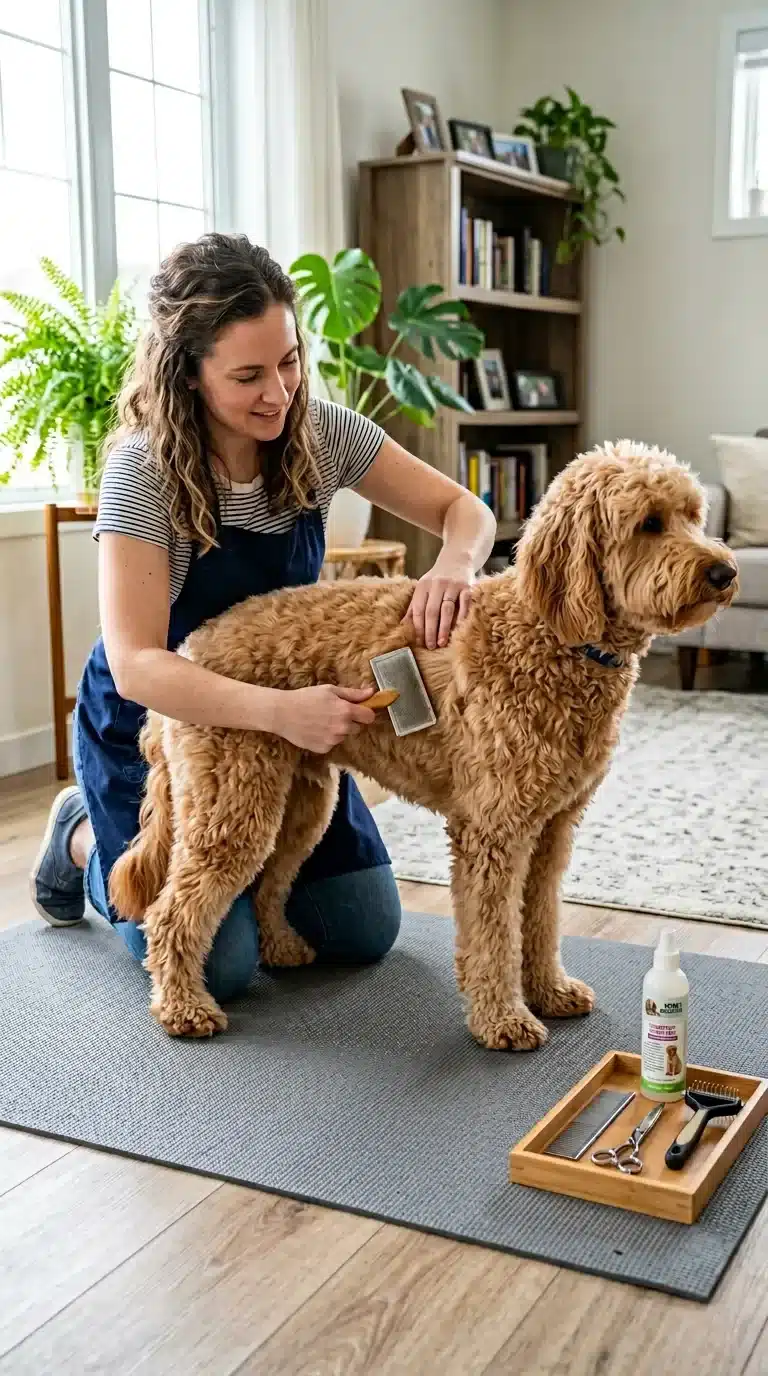
Proper technique matters as much as frequency. Brushing only the surface layer — called “topcoat brushing” — misses the dense undercoat where mats form and gives a false sense of security.
- Part the coat in sections — work in 2–3 inch sections from the skin outward, not top-to-bottom sweeps.
- Use a slicker brush first — a quality slicker brush for Goldendoodles reaches the undercoat and removes loose fur effectively.
- Follow with a metal comb — run a wide-tooth comb through each section to confirm no tangles remain at the root level.
- Target high-friction zones first — armpits, collar area, groin, and behind the ears need attention every session.
- Check for mats by feel, not sight — run fingers against the grain; a hidden mat feels like a firm lump.
- Finish with a light spray — a detangling spray reduces friction and makes future sessions faster.
Success check: if the metal comb slides through every section from root to tip with zero resistance, the coat is fully brushed.
What Happens If You Skip Brushing Too Often
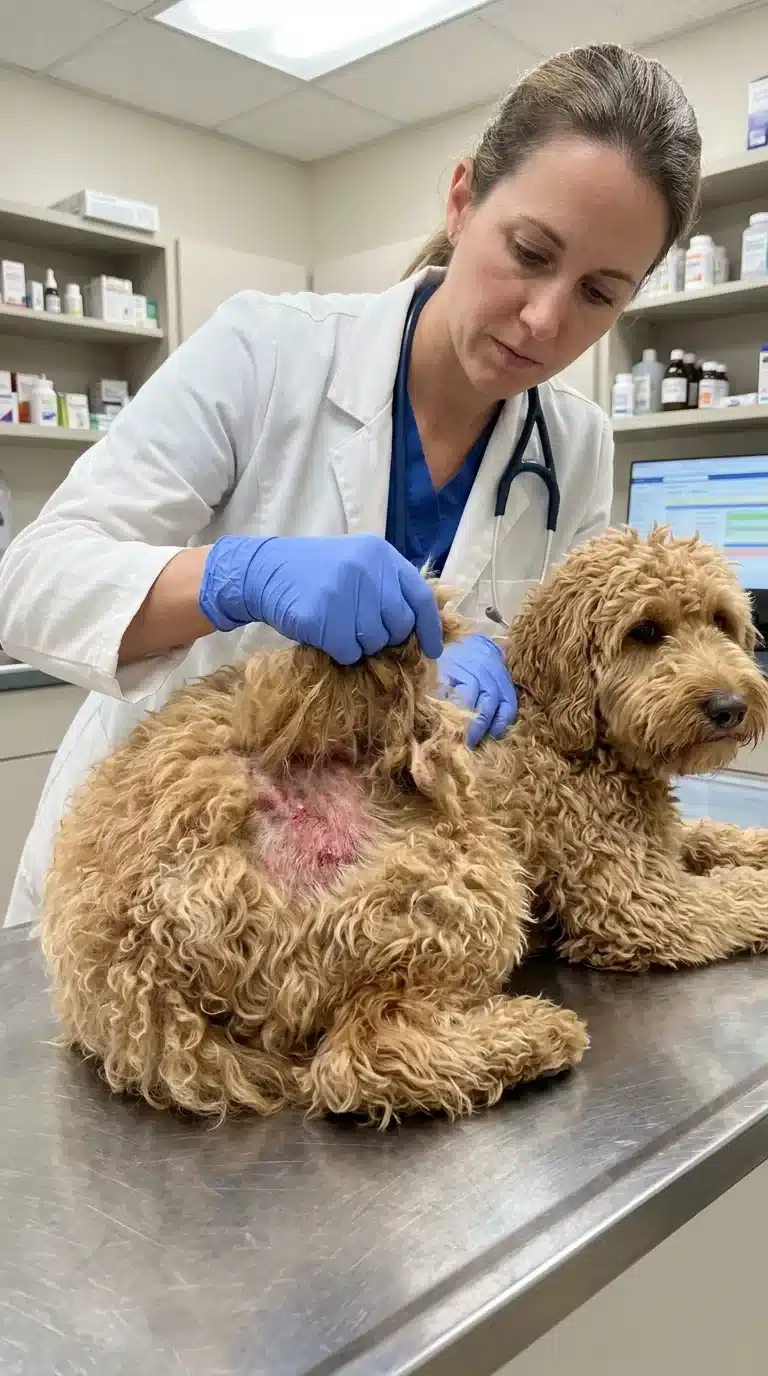
Skipping brushing sessions has real consequences beyond appearance. Mats tighten over time and pull the skin beneath them, causing pain, skin irritation, and in severe cases, hot spots — a type of bacterial skin infection that requires veterinary treatment.
VCA Hospitals notes that severely matted coats can restrict blood flow to skin tissue and trap moisture against the skin, creating conditions favorable for infection. A dog with full-body matting often requires a complete shave-down under sedation.
BEFORE YOU SCROLL PAST
Readers Also Loved:
👉 How To Care For Your Female Frenchie During Her First Heat
“Matting is one of the most preventable causes of skin disease in long-haired dogs. Regular brushing removes the problem before it starts.” — VCA Hospitals, Grooming and Coat Care
Beyond health, neglected coats cost significantly more to correct. A standard groom for a well-maintained medium Goldendoodle runs $65–$90. A dematting session for a neglected coat often reaches $120–$200, with some groomers declining the work entirely and recommending a vet for sedated grooming.
Tools That Make Daily Brushing Realistic
The right tools reduce brushing time from 20+ minutes to 10 minutes or less, which makes daily sessions sustainable. Using the wrong brush — like a paddle brush designed for straight-haired breeds — does almost nothing for a Goldendoodle’s undercoat.
- Slicker brush — the core tool for daily maintenance; look for flexible pins with a curved pad.
- Stainless steel comb (wide/narrow tooth combo) — the final check; if this doesn’t pass through, brushing isn’t done.
- Dematting comb or splitter — for small knots; never yank a mat, always work from the tip inward.
- Detangling spray — reduces friction and static during brushing; safe for dogs when formulated correctly.
A stainless steel grooming comb is the single most important tool for confirming a thorough brush — the slicker brush alone is not enough. Keep both within easy reach to build a consistent routine.
For owners who also manage other breeds with different grooming demands, understanding how much exercise a French Bulldog needs illustrates how breed-specific care requirements vary widely — Goldendoodles are on the high-maintenance end of grooming.
MOST POPULAR THIS WEEK
Readers Also Loved: 👇
👉 How To Stop Dogs From Scratching Ears Raw
Common Goldendoodle Brushing Mistakes to Avoid
- Mistake: Brushing only the top layer. Consequence: mats form at the root level while the surface looks fine. Fix: always section and brush from skin to tip.
- Mistake: Skipping the metal comb check. Consequence: hidden mats go undetected until they’re severe. Fix: end every session with a full comb-through.
- Mistake: Bathing before brushing out mats. Consequence: water causes mats to tighten permanently. Fix: always fully brush before bathing.
- Mistake: Ignoring high-friction zones during short sessions. Consequence: armpit and groin mats develop within days. Fix: hit those zones first, every time.
- Mistake: Extending time between grooms beyond 8 weeks. Consequence: coat length increases matting speed exponentially. Fix: schedule professional grooms every 6–8 weeks maximum.
The American Kennel Club’s Goldendoodle breed information offers additional guidance on coat varieties and general care standards for this popular hybrid.
Frequently Asked Questions About Do I Really Need to Brush My F1 Medium Goldendoodle Every Day?
How often should I brush my F1 Goldendoodle puppy?
Brush your F1 Goldendoodle puppy daily from 6 months onward through the coat transition period, which typically ends by 14–18 months. Daily brushing during this window prevents the severe matting that occurs as puppy and adult coats coexist.
Can I brush my Goldendoodle too much?
Brushing an F1 Goldendoodle daily does not damage the coat when using the correct tools with gentle technique. Over-brushing with excessive pressure can irritate skin, so use a soft slicker brush and avoid scrubbing the scalp.
What brush is best for an F1 Medium Goldendoodle?
A slicker brush paired with a stainless steel wide-tooth comb is the best combination for an F1 Medium Goldendoodle. The slicker brush removes loose fur, and the comb confirms no tangles remain at the root level.
How long does it take to brush a medium Goldendoodle?
A well-maintained medium Goldendoodle takes 10–15 minutes to brush thoroughly. If sessions regularly exceed 20–25 minutes, the coat may need a shorter trim or more frequent brushing to stay manageable.
Does a shorter haircut reduce how often I need to brush?
Yes — keeping an F1 Medium Goldendoodle in a shorter trim (1–2 inch length) significantly reduces matting speed and can lower brushing frequency to 3x per week. Longer styles require daily attention to stay tangle-free.
At what age does an F1 Goldendoodle’s coat stabilize?
An F1 Goldendoodle’s adult coat is typically fully established by 14–18 months of age. After that point, matting risk decreases slightly, though high-friction zones still require consistent brushing regardless of age.
The Bottom Line on Daily Brushing
Daily brushing is the right answer for F1 Medium Goldendoodles during their coat transition phase (6–14 months) and for any dog with a tighter curl pattern. Outside that window, 3–4 times per week is the realistic minimum — not a suggestion.
Start today by checking those high-friction zones: armpits, collar line, and behind the ears. If the metal comb catches anywhere, you’ve found where mats are forming. Fixing small tangles now takes two minutes; ignoring them for a week turns into an expensive grooming bill.
If you enjoy celebrating your dog’s personality beyond grooming routines, you might also appreciate this collection of free Goldendoodle amigurumi crochet patterns — a fun way to honor your dog’s iconic look.