Can Standard Poodles Be Good Family Protection Dogs?

You want a dog that loves your kids, fits your home, and makes a stranger think twice before stepping out of line. It is a short list of breeds that can genuinely do all three. Choosing the right family dog is one of the most consequential pet decisions you will make.
Can Standard Poodles be good family protection dogs? The honest answer surprises most people. This breed combines elite intelligence, physical size, and a deeply loyal temperament — qualities that form the foundation of any serious protection dog.
Can Standard Poodles Be Good Family Protection Dogs?
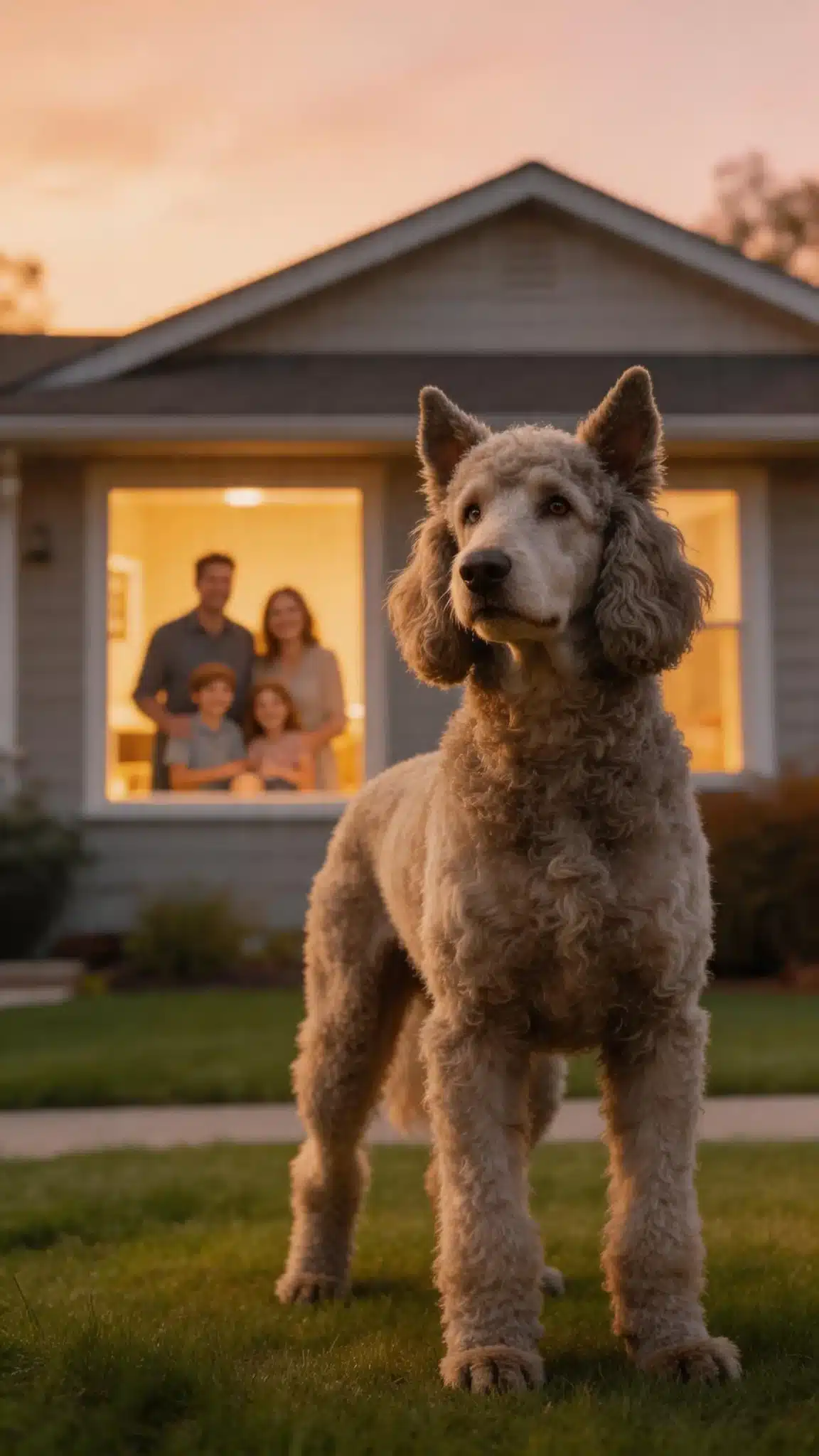
Standard Poodles can be effective family protection dogs when properly trained. They rank among the most intelligent breeds in the world, respond exceptionally well to obedience and protection training, and form strong bonds with their families. While they lack the intimidation factor of breeds like German Shepherds, their alertness, size, and loyalty make them reliable family guardians.
- Standard Poodles stand 15+ inches tall and weigh 40–70 lbs — substantial enough to deter intruders.
- They rank #2 in canine intelligence according to Stanley Coren’s The Intelligence of Dogs (1994).
- Their herding and retrieving instincts translate naturally into protective alertness.
- They are not aggressive by default — protection behavior must be channeled through training.
- Standard Poodles excel in Schutzhund and personal protection dog (PPD) programs.
- Their low-shedding coat is a practical bonus for allergy-prone families.
What Makes a Dog a Good Family Protection Dog?
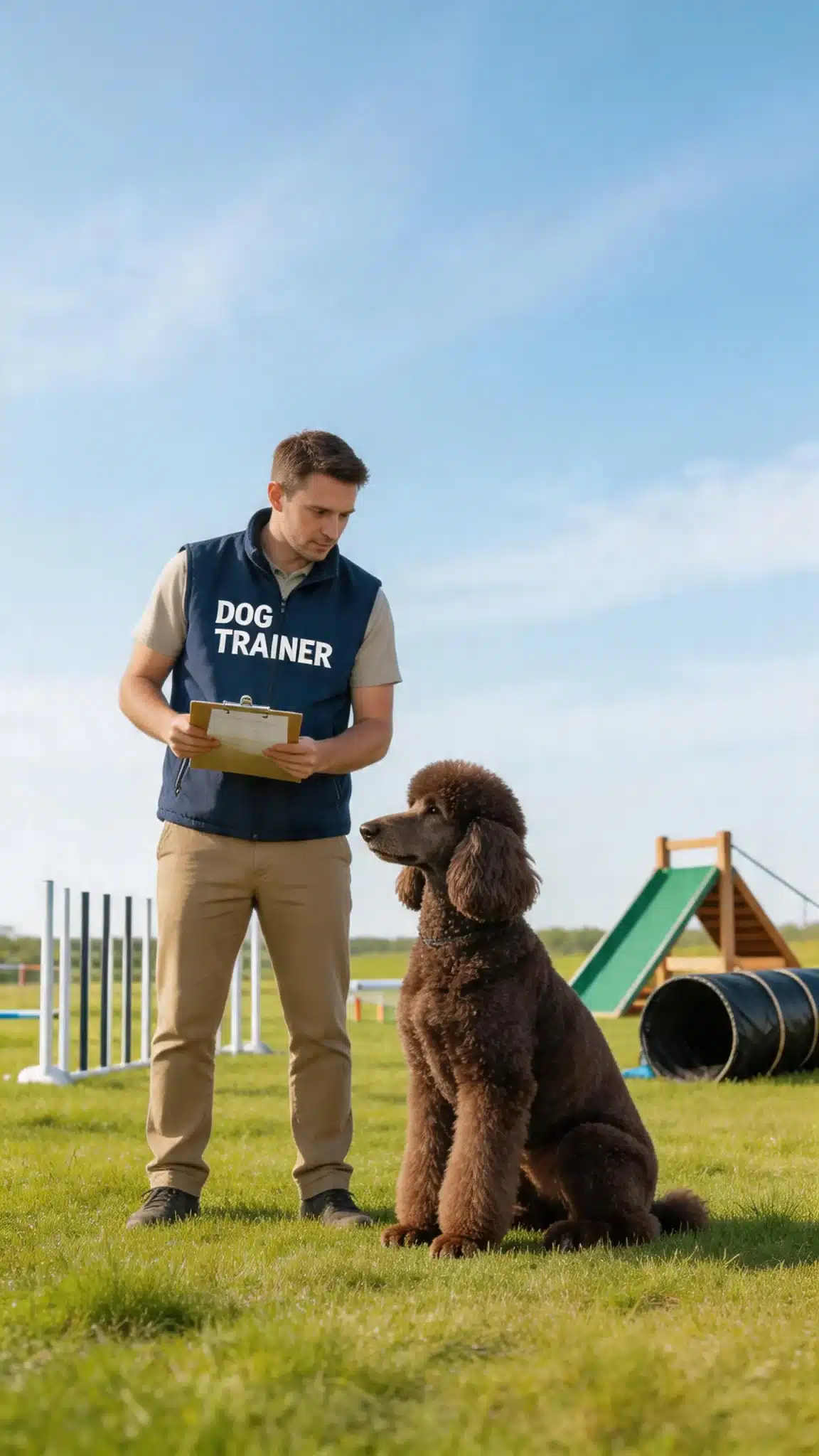
A true family protection dog is not just a dog that barks loudly. It needs intelligence, trainability, a stable temperament, physical presence, and a strong bond with its family — all without being unpredictably aggressive around children.
“The best protection dog is one that is safe enough to be a family pet and capable enough to respond when genuinely needed.” — Ivan Balabanov, world-champion dog trainer and founder of International School for Dog Trainers
Standard Poodles check most of these boxes naturally. Their working-dog origins — they were bred as waterfowl retrievers in Germany, not lap dogs — gave them drive, focus, and physical endurance.
The Five Traits Protection Trainers Look For
- Trainability: Responds to complex commands reliably under pressure.
- Nerves: Stays calm in chaotic environments rather than shutting down or overreacting.
- Drive: Motivated enough to follow through on tasks without constant reinforcement.
- Bond: Deeply attached to a specific family rather than indifferent to its people.
- Physical capability: Large and strong enough to be a credible physical deterrent.
Standard Poodles score high on every one of these traits.
BEFORE YOU SCROLL PAST
Readers Also Loved:
👉 How To Spot Early Signs Of Canine Dementia In Senior Dogs
How Do Standard Poodles Compare to Traditional Protection Breeds?
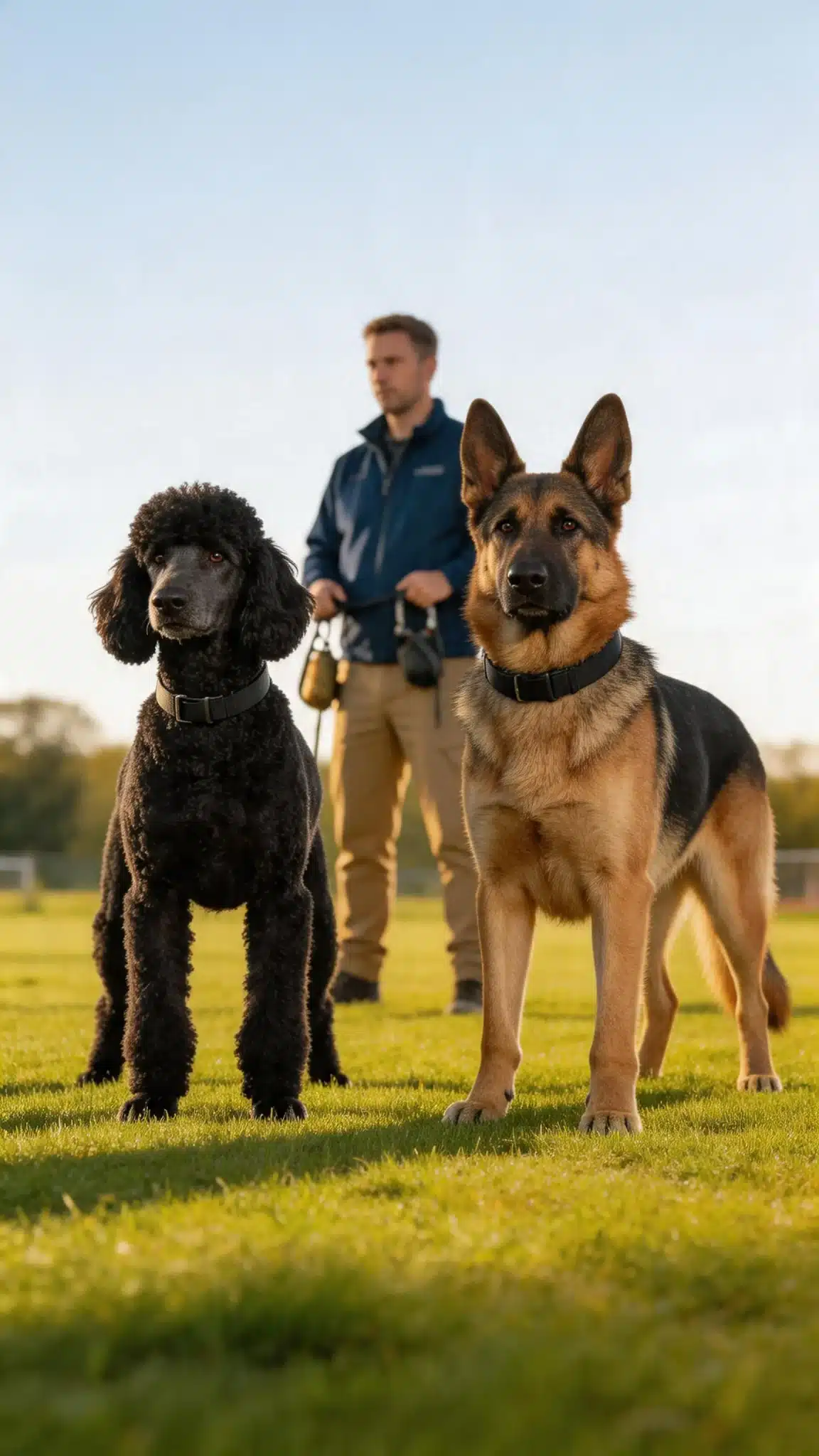
Standard Poodles are not the first breed most people picture for protection work, but a side-by-side comparison with classic protection breeds tells a more balanced story.
| Trait | Standard Poodle | German Shepherd | Doberman Pinscher |
|---|---|---|---|
| Intelligence Rank (Coren) | #2 | #3 | #5 |
| Trainability | Very High | Very High | High |
| Family Friendliness | Excellent | Good | Good |
| Shedding | Minimal | Heavy | Moderate |
| Intimidation Factor | Moderate | High | High |
| Energy Level | High | Very High | High |
The Standard Poodle’s biggest gap versus German Shepherds or Dobermans is visual intimidation. A clipped show Poodle does not signal danger the way a large dark-coated working dog does.
That said, a Poodle kept in a working-style trim looks far more substantial. Many owners of Poodles trained in protection work skip the show cut entirely for exactly this reason.
What Does Standard Poodle Protection Training Actually Look Like?
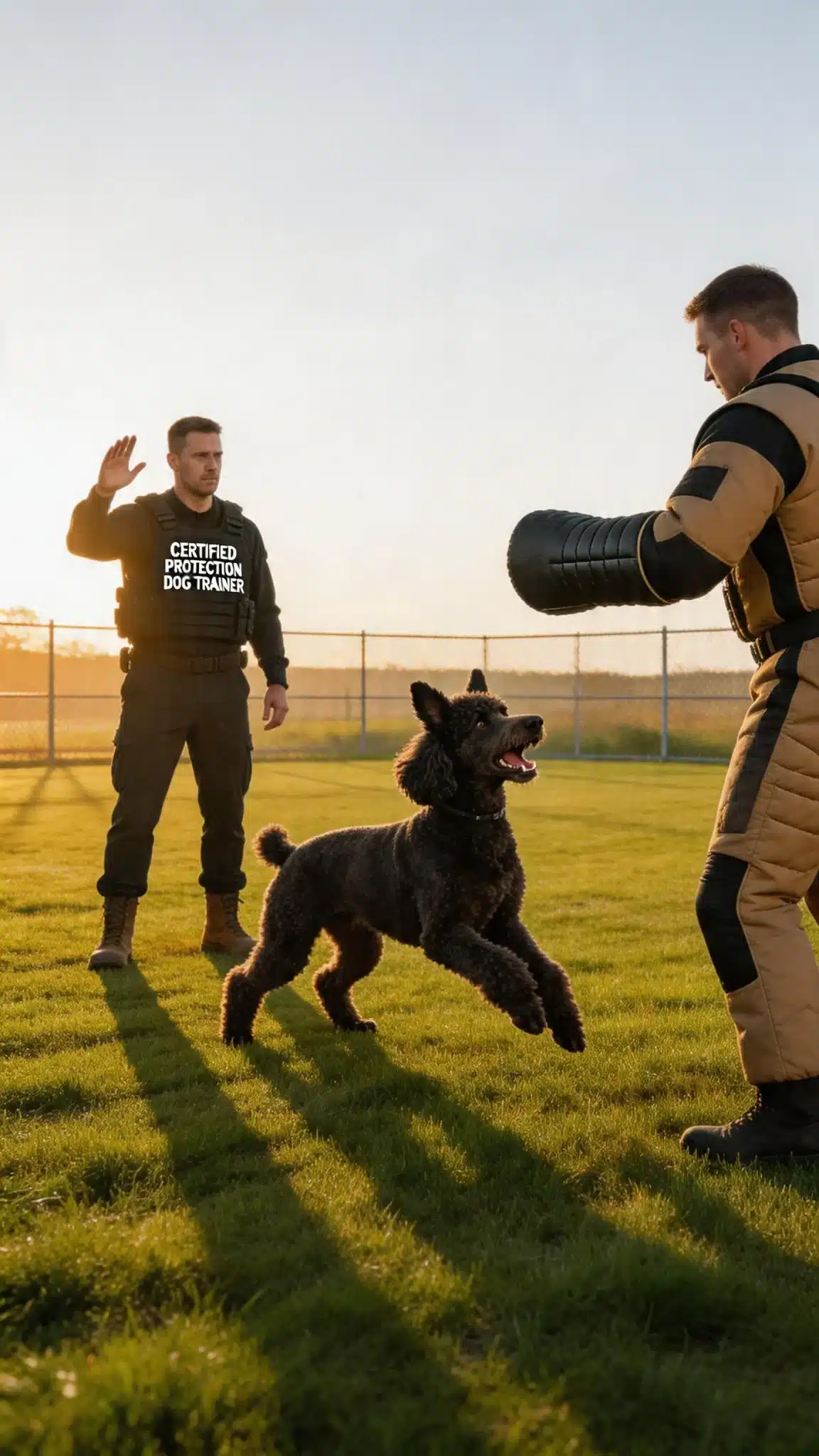
Training a Standard Poodle for family protection is a structured process, not a series of tricks. It starts with obedience and builds toward controlled alert behaviors — never reckless aggression.
- Master foundational obedience first. Your Poodle must respond flawlessly to sit, stay, heel, and recall before any protection work begins. Inconsistent obedience makes protection training dangerous, not useful.
- Build controlled socialization. Expose your dog to strangers, crowds, loud noises, and unfamiliar environments. A protection dog that panics in public is a liability. Success looks like calm curiosity, not fearful barking.
- Introduce scent and alert work. Teach your dog to identify and signal the presence of an unfamiliar person near your home. This is the foundation of watchdog behavior.
- Add boundary training. Establish a clear perimeter your dog understands and monitors. A quality long training lead helps reinforce boundary recall reliably during early stages.
- Work with a certified trainer for bite-work, if desired. If you want a dog capable of physical intervention, hire a professional certified by the International Association of Canine Professionals (IACP) or a Schutzhund club affiliated with the United Schutzhund Clubs of America (USA).
Never skip steps or rush the timeline — a half-trained protection dog creates more risk than it removes.
Avoiding shortcuts in training is one of the most critical dog owner mistakes that affect your dog’s long-term wellbeing and effectiveness.
Are Standard Poodles Safe Around Children During Protection Training?
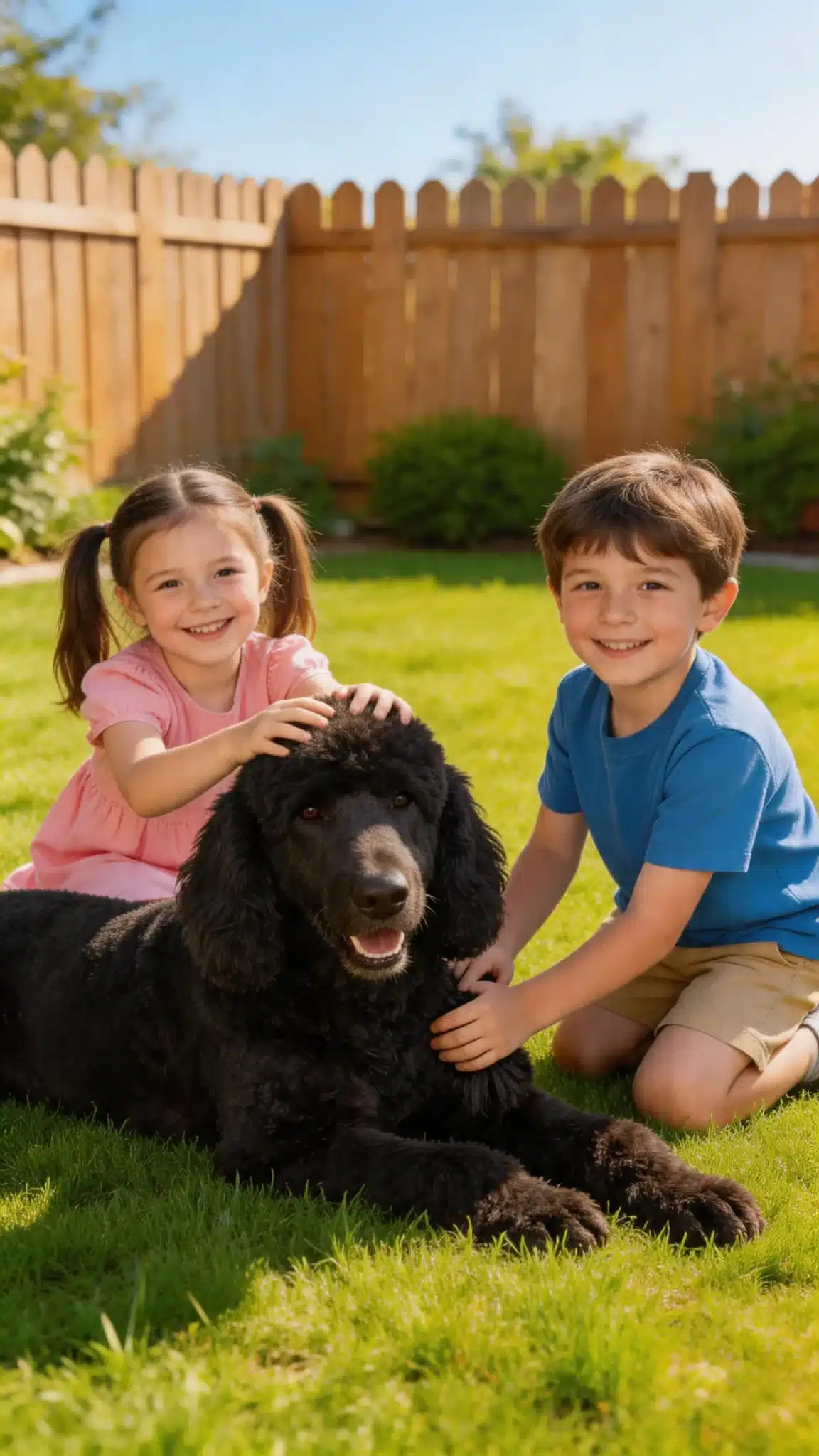
Standard Poodles are consistently ranked among the safest large breeds around children. The American Kennel Club (AKC) describes the Standard Poodle as “proud, very smart, and wickedly funny” with a notably gentle disposition toward family members of all ages.
Protection training does not change this baseline temperament when done correctly. Properly trained protection dogs distinguish clearly between family members and genuine threats — that distinction is built deliberately into the training protocol.
BEFORE YOU SCROLL PAST
Readers Also Loved:
👉 How To Care For Your Female Frenchie During Her First Heat
Child-Safety Markers to Monitor
- The dog shows no resource guarding around kids’ food or toys.
- The dog tolerates unpredictable movement and noise without stiffening or growling.
- The dog defers to adult commands even when children are nearby.
- Alert or protective behavior stops immediately on command.
If your Poodle ever fails any of these markers, pause all protection training and consult a behaviorist. Stability comes first. A dog that is both a loving family companion and capable of performing a working role requires consistent behavioral maintenance — not just initial training.
Common Mistakes When Training Standard Poodles for Protection
Getting this wrong has real consequences. Here are the mistakes that derail otherwise promising protection dogs:
- Encouraging general aggression early. Rewarding a puppy for barking at strangers teaches indiscriminate reactivity, not protection. Fix: reward alerting behavior only, never aggressive lunging or snapping.
- Skipping professional guidance. Protection training without a certified trainer often creates a dog that is unpredictable rather than reliable. Fix: find an IACP-certified trainer before beginning bite-work or advanced deterrence exercises.
- Neglecting mental stimulation. Standard Poodles that are under-stimulated become anxious and may develop false-positive threat responses. A high-quality puzzle toy provides daily cognitive outlets alongside physical exercise. Fix: provide at least 30–45 minutes of structured mental work daily.
- Inconsistent rules across family members. If one person allows jumping on guests and another corrects it, the dog cannot build a consistent threat model. Fix: establish and enforce unified house rules before training begins.
- Choosing protection training to fix a fearful dog. Fear-based aggression and trained protection behavior are completely different. A fearful Standard Poodle needs behavioral rehabilitation, not protection training. Fix: address fear issues with a certified applied animal behaviorist first.
External Resources for Poodle and Protection Dog Research
For verified breed temperament data, the American Kennel Club’s Standard Poodle breed profile is the most reliable starting point. For protection training standards, the International Association of Canine Professionals (IACP) maintains a directory of certified trainers and training standards across the United States.
Frequently Asked Questions About Can Standard Poodles Be Good Family Protection Dogs?
Are Standard Poodles naturally protective of their owners?
Standard Poodles are naturally alert and loyal, which gives them a protective instinct toward their families. They will typically bark to signal unfamiliar people or situations, though full protection behavior requires deliberate training to develop reliably.
How long does it take to train a Standard Poodle for protection work?
Training a Standard Poodle for basic family protection typically takes 6–12 months of consistent work, depending on the dog’s starting point and training intensity. Advanced bite-work or Schutzhund-level training takes longer and requires professional guidance throughout.
MOST POPULAR THIS WEEK
Readers Also Loved: 👇
👉 How To Stop Dogs From Scratching Ears Raw
Do Standard Poodles bark a lot as watchdogs?
Standard Poodles are alert and will bark at unfamiliar sounds or visitors, making them effective watchdogs. They are not excessive barkers by nature, which means their alerts tend to be meaningful rather than constant background noise.
Can a Standard Poodle physically deter an intruder?
A Standard Poodle weighing 50–70 lbs with a confident, trained presence can absolutely deter an intruder. Most deterrence is psychological — an alert, focused large dog signals risk regardless of breed reputation.
Is a Standard Poodle or a German Shepherd better for family protection?
German Shepherds carry stronger visual intimidation and a deeper history in police and military work, while Standard Poodles offer equal trainability with better allergy compatibility and family gentleness. The right choice depends on your household’s specific priorities and lifestyle.
What age should I start protection training a Standard Poodle?
Begin foundational obedience training at 8–12 weeks old. Formal protection work should not start until your Poodle is at least 18–24 months old, when its temperament has fully stabilized and basic obedience is rock-solid.
The Bottom Line on Standard Poodles as Family Protection Dogs
Standard Poodles can absolutely be good family protection dogs — and they do it while being gentle with children, easy on allergies, and genuinely enjoyable to live with. The breed’s elite intelligence and trainability make it one of the most overlooked options in this category.
The single most important takeaway: protection ability is built, not assumed. A Standard Poodle with structured training from a certified professional will consistently outperform an untrained dog of any traditionally “tough” breed.
Your concrete next step today is to contact an IACP-certified trainer in your area, bring your Standard Poodle’s current obedience records, and ask for an honest temperament assessment. That one conversation will tell you exactly what your dog is capable of — and map out the path to get there. Just as understanding what makes any breed genuinely good requires looking past surface-level assumptions, so does evaluating the Standard Poodle fairly.