
Apoquel Vs Cytopoint For Ear Itching: Which Works Better For Bully Breeds?

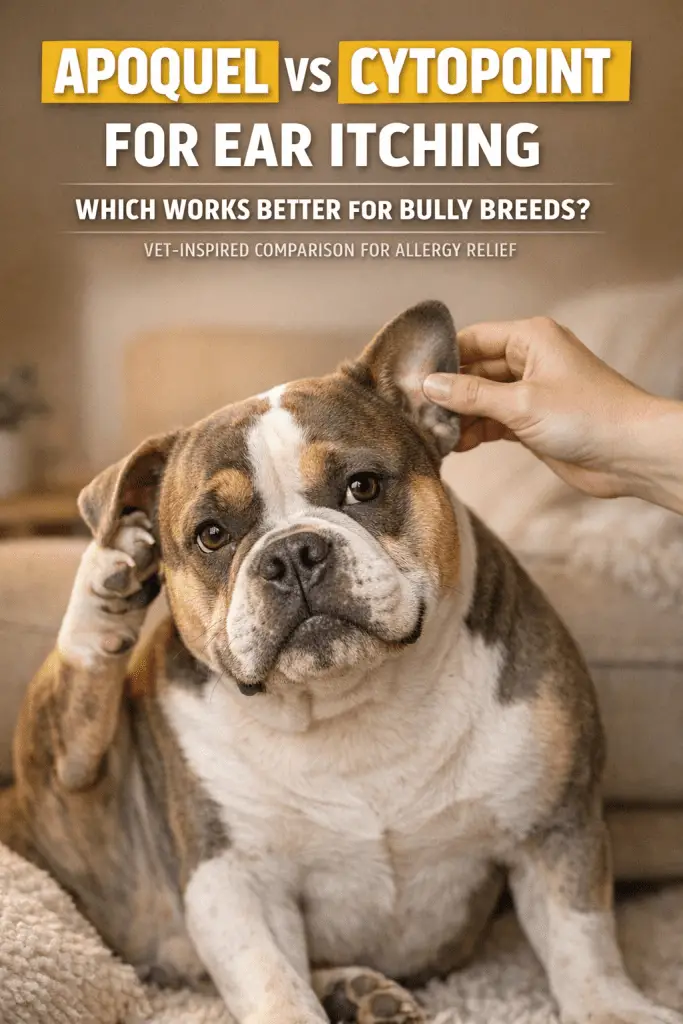
If you have a Bully breed (American Bully, English Bulldog, Frenchie, Olde English Bulldogge, etc.) who won’t stop scratching their ears, I know how stressful it feels. You’re trying to sleep, your dog is shaking their head at 2 AM, and suddenly you’re staring at red, smelly ears and wondering: Is this allergies? Yeast? An infection? All of the above?
And then you hear two names over and over: Apoquel and Cytopoint.
They’re both popular. They’re both vet-prescribed. And they can both help a lot—but they’re not identical, and for ear itching (especially in bully breeds), the “best” one depends on what’s really driving the itch.
In my experience, the big win is when you pick the option that matches your dog’s pattern: daily flares vs. seasonal spikes, needle tolerance vs. pill tolerance, infection-prone ears vs. mostly clean ears, and whether you need something you can stop instantly if it doesn’t feel right.
Let’s make this simple and practical—so you can talk to your vet with confidence and get your dog comfortable again.
Quick answer: Apoquel vs Cytopoint for bully-breed ear itching
If your bully breed’s ear itching is allergy-driven (atopy), both Apoquel and Cytopoint can work well—but they fit different situations.
Most bully-breed owners tend to prefer Cytopoint when:
- You want longer relief (often weeks) without daily meds.
- Your dog is hard to medicate (pills are a fight)
- You want a treatment that’s not a daily immunomodulating pill
- Your dog has itchy ears + itchy body, and flares come in waves
Apoquel is often the better fit when:
- You want something you can start and stop quickly (more control)
- You need day-to-day flexibility (adjust with your vet)
- You want an oral option for allergic itch and atopic dermatitis in dogs 12+ months.
Key takeaways (save this):
- Cytopoint can start helping fast (even within hours in studies) and can last 4–8 weeks for many dogs.
- Apoquel is a daily pill and is labeled for allergic itch/atopic dermatitis in dogs 12 months+ .
- If your dog’s ears are itchy because of yeast or bacterial infection, neither option fixes the infection by itself—you still need ear treatment/cleaning (vet-guided)
- Bully breeds commonly have allergy patterns that show up in ears, and recurring ear infections are a huge clue you need a full plan, not just itch control (Cornell Vet School)
- If you’re seeing pain, swelling, bad smell, pus, head tilt, or crying, treat it like an ear problem first—then decide Apoquel vs Cytopoint
Practical “right now” tips:
- If the ear is smelly, wet, gunky, or painful: book a vet ear exam + cytology (this is what stops the repeat cycle)
- If you’re already cleaning at home: use an ear cleaner your dog tolerates and don’t over-clean inflamed ears (your vet can tell you frequency)
- If your dog is constantly itchy, ask your vet about a combined approach: itch control (Apoquel/Cytopoint) + ear infection plan + allergy prevention
Why bully breeds get ear itching so often
Here’s the frustrating truth: bully breeds are basically the “perfect storm” for ear issues.
1) Allergies love to show up in the ears
Many dogs with environmental allergies (atopic dermatitis) itch their paws, face, belly, and ears. Cornell notes atopic dermatitis is common and may affect around 10–15% of dogs.
2) The ear canal becomes a “microbe party”
Once the skin is inflamed from allergies, the ear canal environment changes. That can lead to:
- Yeast overgrowth
- Bacterial infections
- More itch → more scratching → more inflammation → more infection
This is why bully-breed ear problems are often recurring until you address the underlying allergy pattern.
3) Anatomy and skin folds can make it worse
Some bully breeds have ear shape/skin traits that trap moisture and heat—great for microbes, terrible for comfort.
If your dog also has frequent skin flare-ups, consider pairing your allergy plan with supportive care like diet/skin support and ear hygiene. For product ideas, you can browse resources like Best ear cleaner for French Bulldog puppies and Best ear wash for French Bulldog (helpful for routine maintenance, not a replacement for vet meds).
Apoquel: what it is and when it tends to shine
Apoquel (oclacitinib) is a prescription tablet used to control itch (pruritus) associated with allergic dermatitis and the clinical signs of atopic dermatitis in dogs. The Zoetis prescribing information includes use in dogs at least 12 months of age.
Why bully-breed owners like Apoquel
In real life, Apoquel is popular because it’s:
- Fast and flexible (you and your vet can adjust, pause, switch)
- A daily routine (some people like the predictability)
- Helpful when the dog has ongoing daily itch that needs consistent control
When Apoquel can be a better match
Apoquel often fits better if:
- Your dog has frequent flare-ups and you want to respond quickly
- You want something you can stop immediately if your dog gets sick or your vet wants to re-check something
- You’re managing multiple moving parts (diet trial, ear infection meds, allergy testing, etc.)
Common “Apoquel disappointment” pattern (important)
If your bully’s ears are still raging on Apoquel, it can mean:
- The ear itch is primarily infection-driven (yeast/bacteria)
- Your dog needs better ear control (cleaning + targeted medication)
- The allergy load is high and you need a stronger multi-step plan (sometimes Cytopoint or immunotherapy becomes the next step)
Cytopoint: what it is and why it’s a favorite for many itchy dogs
Cytopoint (lokivetmab) is an injection that targets IL-31, a key itch signal in many allergic dogs. In official product information, lokivetmab showed an onset of efficacy for pruritus by the first measured time point at 8 hours in a laboratory model study.
Many dogs then get weeks of relief from a single injection (Zoetis commonly describes 4 to 8 weeks of relief).
Why bully-breed owners love Cytopoint
Cytopoint is often chosen because:
- No daily pill battle
- Great for dogs who get seasonal “itch explosions”
- Owners like the “set it and forget it” rhythm (with vet follow-ups)
When Cytopoint can be a better match
Cytopoint tends to be a strong fit if:
- Your dog’s itch is clearly allergy-driven
- You want fewer daily medications
- Your dog is sensitive to lots of meds or you’re trying to simplify the routine
One big reality check
Just like Apoquel, Cytopoint does not treat an active ear infection by itself. It can reduce the itch signal, but if there’s yeast or bacteria in there, you still need an ear plan.
Side-by-side comparison for bully-breed ear itching
Best “fit” situations (simple version)
Pick Apoquel (often) when:
- You need day-to-day control
- You want quick stop/start flexibility
- You’re in the “testing phase” (diet trial, new home, seasonal shift)
Pick Cytopoint (often) when:
- You want longer-lasting relief with fewer daily meds.
- Your dog is a nightmare to pill
- Your dog’s itch is mostly allergy-driven and flares are predictable
What about safety and “stronger”?
This is where I like to keep it real: both are legitimate veterinary options, and your vet will weigh your dog’s age, health history, infection history, and vaccination schedule.
If you want a broad, modern overview of allergy management options, the 2023 AAHA Management of Allergic Skin Diseases guidelines are a strong reference point (and very “real-world vet clinic” friendly). (AAHA)
Also worth noting as a trend: newer allergy/itch drugs have entered the conversation in recent years, including FDA approval news around a newer JAK inhibitor (Zenrelia) in 2024—basically showing how active and evolving this space is.
Step-by-step: how to decide with your vet (without guessing)
Here’s the exact process I’d follow if this were my dog.
Step 1: Confirm it’s not “infection first”
Ask your vet for an ear exam and ideally ear cytology if:
- Smell is strong
- Discharge is brown/yellow/green
- Ear is painful, swollen, hot, or bleeding
- Your dog tilts head or seems off-balance
If infection is present, treat that first (or alongside itch control). Otherwise you end up in the loop: meds help a little → infection stays → itch returns.
Step 2: Identify the itch pattern
Tell your vet which one sounds like your dog:
- Pattern A (daily itch): itching most days, not just seasons
- Pattern B (seasonal spikes): spring/fall explosions, then calmer months
- Pattern C (ears-only flare): ears are the main battlefield
- Pattern D (whole body + ears): paws, face, belly, ears all involved
This pattern alone often hints which med fits your lifestyle better.
Step 3: Decide based on your real life
Be honest about:
- Can you pill your dog daily?
- Do you prefer injections every few weeks?
- Are you trying to simplify because you’re already doing wipes, baths, diets, etc.?
Step 4: Build the “ear support layer”
Even the best itch med won’t feel like a miracle if ears are constantly irritated.
Helpful reads you can explore:
- Best allergy medicine for French Bulldog (for broader allergy support ideas)
- Best dog food for French Bulldog with allergies (diet sensitivity angle) (My Blog)
- What is the best dog food for French Bulldogs? (foundation nutrition)
(These don’t replace vet treatment, but they help owners build a complete plan.)
Common mistakes that keep bully-breed ear itching coming back
Mistake 1: Treating itch but ignoring the ear infection
This is the #1 reason people feel like Apoquel or Cytopoint “stopped working.”
Mistake 2: Over-cleaning angry ears
If the ear canal is inflamed and you clean aggressively, it can worsen irritation. Your vet can recommend frequency and product type (routine cleaner vs medicated).
Mistake 3: Not addressing the allergy root
If a bully breed has repeat ear issues, think bigger:
- Environmental allergies
- Food sensitivities (sometimes)
- Chronic yeast/bacteria cycles
Mistake 4: Waiting too long on red flags
If you see head tilt, balance issues, severe pain, or swelling—don’t wait. Those signs can mean deeper ear involvement.
FAQs: Apoquel vs Cytopoint for bully-breed ear itching
1) Which works faster for ear itching: Apoquel or Cytopoint?
Both can work quickly in allergic itch situations. Cytopoint has documented onset of efficacy in a lab model by 8 hours. (zoetis.ie)
In real life, “fastest” depends on whether the itch is allergy-driven or infection-driven.
2) Can I use Cytopoint if my dog has an ear infection?
Your vet can—but Cytopoint doesn’t treat the infection. You’ll still need ear-specific treatment if yeast/bacteria are present.
3) Can a bully breed take Apoquel long-term?
Many dogs do, but it’s a vet decision based on health history and monitoring. Apoquel is labeled for allergic pruritus/atopic dermatitis and has age/weight-related restrictions in product labeling.
4) Why is my dog still itching after Cytopoint?
Common reasons:
- Active ear infection
- Allergy trigger is intense (seasonal peak)
- Another cause (mites, foreign body, endocrine issues)
This is where an ear exam + cytology helps a lot.
5) Do bully breeds need a different approach than other dogs?
Often, yes—because they’re more likely to have recurring skin/ear inflammation patterns that need a layered plan (itch control + infection control + prevention + diet/skin support).
6) What’s the “best” plan if my bully has nonstop ear itching?
In my opinion, the best results come from:
- Confirm/treat infection
- Choose Apoquel or Cytopoint for itch control
- Add routine ear hygiene + allergy prevention
- Recheck and adjust before it becomes chronic
Conclusion
If your bully breed is chewing, scratching, and shaking their head nonstop, you’re not being “dramatic” for wanting relief fast. Ear itching is miserable—for your dog and for you.
Apoquel is often great when you want daily control and flexibility.
Cytopoint is often great when you want longer relief with fewer daily meds and your dog’s itch is strongly allergy-driven.
But here’s the most important takeaway: if the ears are infected, treat that first (or alongside)—because itch meds don’t kill yeast or bacteria.